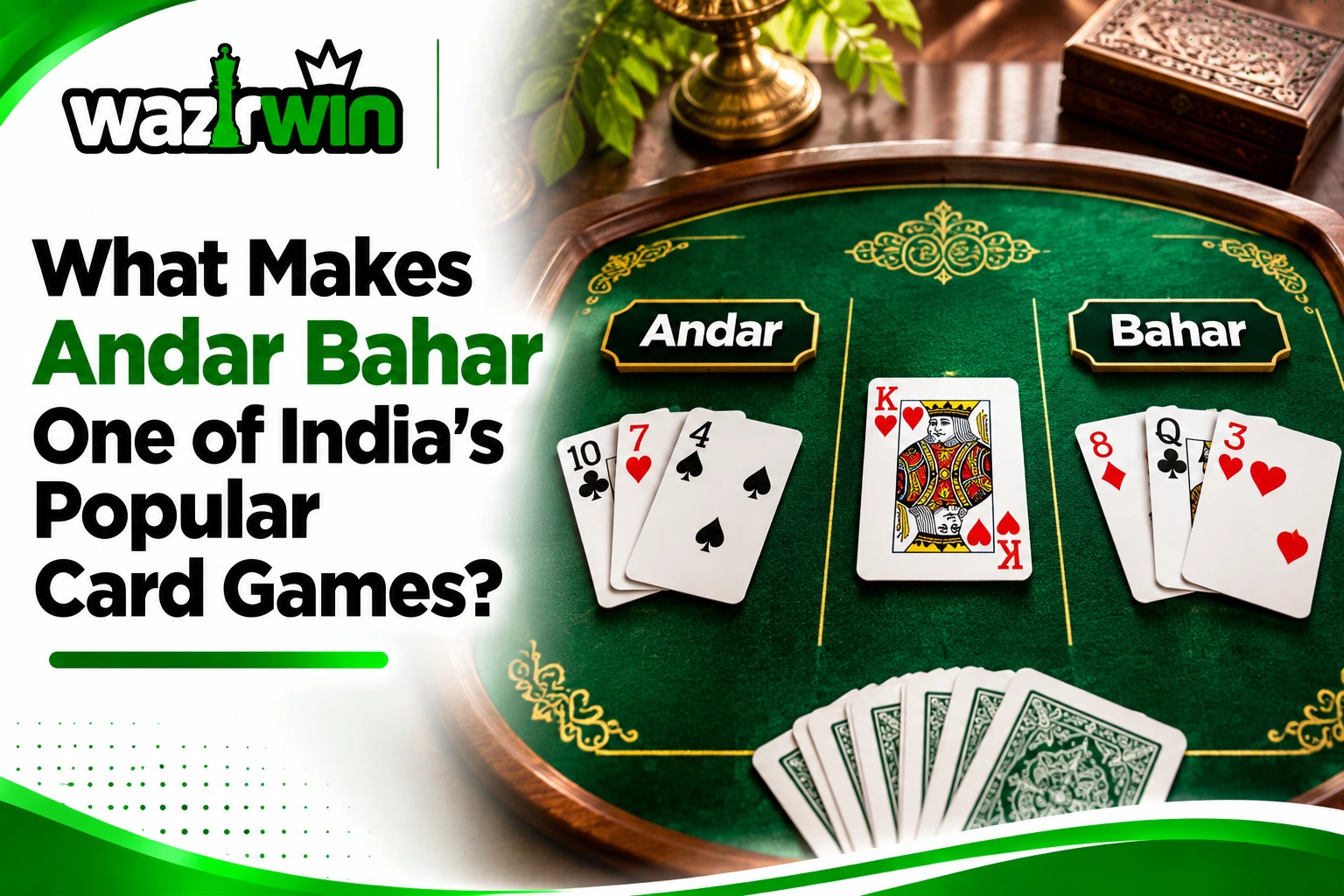
Card Games of India – Played throughout the festivals, family gatherings and social events of India. Some are simple to play whilst others create much excitement playing them against other players sitting around a table. Andar is one of the most popular games played with a deck of cards as part of the Indian card games.
In the Andar game there are two sides of the table playing against each other. In contrast to games where a player has to memorize combination after combination of cards in Andar, a player just needs to understand the common terms and play the game at a very fast pace. The ease of terms and playing the Andar game at a very fast pace has made it a favorite pastime of masses in various parts of the country
The name of Andar and Bahar is a well known term in the Hindi language, hence Andar is a very well known concept among the people of India. It is not very hard to find discussions on the traditional Andar-Bahar game as well as the online versions of the same game.
This article explains why Andar is a very popular Indian card game, explains how Andar is played, introduces its historical roots and why Andar is so different from other popular Indian card games.
What Is Andar Bahar?
Andar Bahar is a well known traditional Indian card game played with a deck of 52 cards. The game originated in the southern part of India. It is most commonly played in Bengaluru, Karnataka. The exact origin of this game and its history is largely unknown.
The game is known by the following names:
- Andar: Refers to “inside.”
- Bahar: Refers to “outside.”
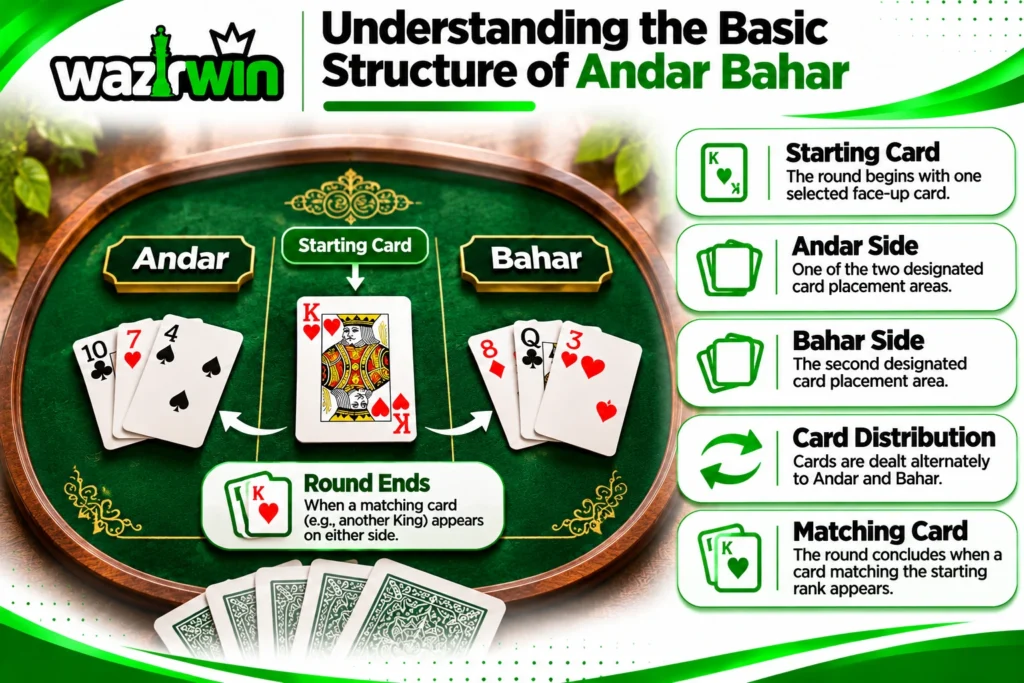
One card is placed face up in the center of the table. This is the reference card for that round of Andar. The dealer then alternately deals cards on the Andar side and the Bahar side. The round ends when a card of the same rank as the reference card is exposed.
The game is simple to recognize and play as there are no complex card combinations to remember and follow. A player does not have to memorize long sequences of actions and decisions in playing the game.
This popular Indian card game is known by many different names in different regions and even by variations of games played with cards.
Table of Contents
Why Is Andar Bahar Popular Across India?
Why a Traditional Card Game is Popular: The experience of a traditional card game is made up of more than its rules. It includes a player’s knowledge of a culture, ease of access to a game and a fun social experience.
There are several points to be discussed while comparing this card game with other popular Indian card games.
1. Simple and Easy-to-Understand Rules
The main reason this game is popular is because of the simple rules to learn. Unlike other card games where a person has to memorize many different combinations and sequences of play, this game only requires a player to understand how to rank cards from highest to lowest. Within each round of this game, there is an open middle card and players are dealt cards between two opposing sides. A player tries to search for a card of the same rank as the open card until he finds it. After that, the rest of the game is fairly straightforward to play.
2. Strong Connection with Indian Card-Playing Culture
Teen Patti and Rummy are two of the most common card games played in India, generally played in family gatherings or special events. Andar Bahar on the other hand is a game which is played traditionally all over India and is also played in most of the Casinos around the world.
3. Quick and Easy-to-Follow Rounds
Each round is easy to explain from start to finish and so easy to learn to play. For that reason, we have covered this popular card game in a lot of in-depth articles in order to best explain to others how to play this increasingly popular game.
4. Familiar Andar and Bahar Terminology
Terms associated with games are generally more remembered than not. The two words ‘Andar’ and ‘Bahar’ in the name Andar are most familiar with individuals who speak Hindi and can associate these terms to within the cards that are dealt while players search to find matching cards in the ‘Andar’ pile and the ‘Bahar’ pile. This assists in remembering a traditional game like Andar, especially in comparison to International Card Games.
5. Social Interaction and Shared Entertainment
In general, games are popular as they lead to great entertainment when played in households or when friends come over to socialize. The game described above leads to a lot of great conversation, and as the cards are dealt, players can get caught up in the experience of the game, watching other players on opposite sides of the table and cheering them on.
6. Regional Recognition & Different Names
Another example of games where cards are shown on the inside-and-outside of the deck are Mangatha or Ullae Veliyae (South India). It is well known that many card games are played and even referred to in different terms depending on the local language or even the terms used by people living in the same place but of different communities.
Understanding the Basic Structure of Andar Bahar
The basic format of a card game is easy to follow.
This simple game can be played with a normal 52 card deck of playing cards. A card in the middle of the deck is revealed by the dealer and the rest of the cards are distributed to the two sides, Andar and Bahar.
The general sequence is:
- A standard deck is shuffled.
- One card is revealed and placed in the center.
- The two sides, Andar and Bahar, are designated.
- The cards are dealt alternately between the two sides.
- The round is over when a card with the same rank as the central card appears.
- Thus in this simple form, it is only the rank of the Card that is important, not the suit.
The explanation given can deviate from the rules of traditional games as well as of computer versions. Thus, the general explanation should not be regarded as a complete set of rules for all versions of the game.
What Makes the Game Different from Other Indian Card Games?
In India, a variety of card games are played with unique game structures. While some games are mostly between a player and the dealer against other players taking the opposite side making individual playing decisions, there are games which emphasize formation of combinations, sequences or even playing memory.
Comparison of well known games to play with a deck of cards.
| Feature | Andar Bahar | Teen Patti | Rummy |
| Basic structure | Two sides and a middle card | Three-card combinations | Sets and sequences |
| Main focus | Matching card rank | Comparing card combinations | Organizing cards into valid groups |
| Complexity | Simple basic format | Varies based on the specific variation | Requires understanding of sequences and sets |
| Player involvement | Follows the dealer’s card distribution | Players make decisions during rounds | Players draw and discard cards |
| Familiarity | Traditional Indian card game | Widely recognized Indian card game | Popular in several formats |
There are many more variations of the card-games. Even within the three games mentioned above, Game is the simplest to understand whereas games like Teen Patti and Rummy are based on a number of card-combinations and player’s decisions. For more information on other popular table games and their formats, you can refer to WazirWin’s guide to online casino table games.
Traditional Card Games and Their Digital Presence
Information about traditional games and local card games are increasingly spread through digital articles, videos and comprehensive gaming resources on the internet. In the past such information was mostly handed down from family members or friends and spread through communities.
Andar Bahar is a topic much discussed in online card-game communities. Articles, videos and even websites dedicated to games can include explanations of the game with visual representations of a card table, automated dealing and even varied interface designs.
While there may be digital versions created and showcased online, they do not compare to the real experience of playing physical cards at gatherings and other social events.
Many online gaming resources can be freely viewed, played online for free or as part of social games. However there are also many online gaming resources that offer games for money, or provide rewards or compensation in some form. Rules for such gaming can differ from location to location and will be subject to local laws.
Important Features That Make the Game Recognisable
There are a number of basic elements to the card game of Andar Bahar which to most people would describe a fairly basic structured game. The elements of the game such as the middle reference card, dealer distribution of cards to both Andar and Bahar sides, the two sides to the game, the use of Standard 52-card decks (without jokers) and the suits and cards in each suit, all help to facilitate players’ understanding of how the game is played.
The Middle Reference Card
The middle reference card is put face up on the playing area by the dealer before he distributes the rest of the cards. This middle reference card is very important, because the rank of this card is the rank that players must search for in the remaining cards. They can see the reference card all the time while the rest of the cards are distributed in the two sides of Andar and Bahar.
Two Distinct Sides
Andar and Bahar: Two Separate Sides to the Card Game The two distinct sides of the Andar or Bahar card game are the space where the cards are distributed during the round and are clearly marked to allow the player to easily know where a card was placed.
Standard Playing Cards
Andar Bahar is typically played with a standard 52 card deck containing no jokers. A standard 52 card deck consists of 4 suits, Hearts, Diamonds, Clubs and Spades, with 13 cards of each suit. These 13 cards are the 2, 3, 4, 5, 6, 7, 8, 9, 10 and the face cards of each suit, i.e. Jack, Queen and King of each suit along with the Ace of each suit.
Dealer-Based Distribution
As mentioned before, a Dealer Based Distribution is adopted for the cards in the Andar or Bahar game. So unlike Rummy games where players draw cards and discard cards in Alternating turns, in the case of Andar Bahar game, the cards are distributed by the Dealer. Firstly a reference card is placed in the center of the table. Then cards are dealt alternately on either side of the reference card placed at the center.
A Clearly Defined Ending
Andar Bahar has a clearly defined ending for each round of play. That ending occurs when a card that matches the middle reference card is revealed, whether it is on the Andar side or the Bahar side of play. For that reason, it is one of the easiest games to learn for people that are not familiar with games that are traditionally played with cards. And, every round of Andar Bahar begins exactly the same and ends exactly the same.
Is Andar Bahar a Game of Skill or Chance?
When discussing the rules of a card game and its popularity, it is first important to understand the nature of the game.
This is a typical representation of the game of Andar that is often offered in various forms around the web. The format of the game of Andar is generally a game of chance in that the sequence of the cards is random and is affected only by how one deals the cards from a previously shuffled deck of cards.
Games where the player is making ongoing decisions with respect to card combinations, memory and strategy are entirely different from Andar.
It is also important to note that because a game is a traditional game does not mean that all online versions of the game are also legal. The online version is offered as a specific format, includes financial components and therefore is subject to specific provisions and regulations.
Responsible Awareness Around Online Card Games in India

Interest in traditional card games should not be confused with interest in online money games.
India’s Promotion and Regulation of Online Gaming Act, 2025 (hereinafter referred to as “PONGO Act 2025”) prohibits online money games and associated services with respect to their offering or facilitation. Promotion and Regulation of Online Gaming Rules, 2026 (hereinafter referred to as “PONGO Rules 2026”) came into effect on 1st May, 2026. The said framework relates to advertising and financial transactions also related to online gaming.
Hence, it is wrong to gauge the legality of money games played online, based on the popularity of a card game played in a traditional manner. The legality depends on various criteria and is subject to the pertinent legal framework.
For general information regarding other sports, games and entertainment topics please visit WazirWin.
Why Traditional Indian Card Games Continue to Attract Attention
While online gaming is increasingly finding favor with masses all over the world, the traditional card games have a considerable following in India. Card games are largely popular as they are easy to understand and can be played in simple manner.
Andar is a game which is easily explainable. A card is placed in the center of the playing area, the two sides of the card are known and there is a method of dealing the cards by the dealer of the game. Andar is played all over the country and is well known in almost all regions of India with players having their own local vocabulary for the game.
It is essential to make a distinction between the heritage of a game and the rules of the game as they have been practiced hitherto and the modern online versions of the game including all commercial ventures that are currently operating online. Our appreciation of this ancient game should help in enabling the audiences to appreciate the game in its standalone form as against its online versions.
Frequently Asked Questions
1. What is Andar or Bahar?
The name of the popular Indian Game “Andar or Bahar” comes from the 52 card deck used to play the Game and the way the two sides of the Game (Andar and Bahar) are played with reference to the central card (middle card) in the round.
2. Why is Andar or Bahar popular in India?
In simple words, Andar or Bahar’s popularity can be because of the simple game format, familiar names, local connectivity and because of the culture of playing cards amongst masses of India.
3. What do Andar and Bahar mean?
Andar means inside, while Bahar means outside. These are the two terms that are used to describe the two sides to play on in the basic format of the game.
4. How many cards are used in the traditional format?
A full deck of 52 cards is used for the traditional Andar or Bahar format.
5. What is the purpose of the middle card?
A round of Andar or Bahar is completed when a card of the same rank as the middle card is drawn from either the Andar side or the Bahar side of play.
6. Is Andar or Bahar similar to Teen Patti?
This is in contrast to Teen Patti (also known as Indian Flash or Indian Poker), which is played by players comparing the ranks of their three card hands.
7. Is Andar or Bahar known by other names?
In places, it is known as Mangatha or Ullae Veliyae. Names for Andar or Bahar vary all over the country, even the way in which the games are played differs greatly from place to place.
8. Is Andar or Bahar a game of skill?
Traditional Andar or Bahar format is entirely a game of chance since there is no way to predict the sequence of cards that are dealt from a shuffled deck.
9. Is Andar or Bahar played with a regular deck of cards?
Yes, it can be played with a regular deck of cards that has 52 playing cards in it.
10. Is online money-based Andar or bahar permitted in India?
Money-based online games such as Andar or Bahar including all money-based related online services have been prohibited under India’s Promotion and Regulation of Online Gaming Act, 2025. This piece aims to clarify between knowing how to play Andar or Bahar and playing online money-based versions while strictly following the law.