In cricket there are several variations of a match. First of all, there is test cricket, which requires a lot of patience and accuracy of technique. Then there is one day cricket, or ODI’s, which is a merger of long lasting games with aggressive and fast cricket. Twenty20 games on the other hand are played at a rapid tempo. They consist of a short game, in which a team has to try to score as many runs as possible within a limited amount of time using a limited number of overs.
T20 Cricket is a great way for new fans to learn about cricket. This short format gives fans an insight into how teams would set up their strategy for an innings, how the powerplay operates, all the restrictions on the bowler, and more, compared to Test and ODI matches.
In online cricket circles, you will often come across the term T20 Cricket Betting ID. The rules and structures of a cricket match are quite distinct from participating in online cricket betting and this guide explains the ins and outs of the game and how it compares to ODI’s and Test Match cricket.
What Is the T20 Cricket Format?
T20 or Twenty20 cricket is a form of limited overs cricket. Typically each team would have 20 overs to try and score as many runs as possible. This means a standard over is 6 deliveries, thus in the best case scenario a game would contain 120 valid deliveries (i.e. before the delivery limit for both sides is reached).
A T20 match typically includes two innings:
- The first team bats and scores as many runs as possible.
- The second team will attempt to score enough runs to better the first team’s score.
- The team with the most runs at the end of the two innings is the winner of the game.
A team’s innings will come to an end earlier if they get bowled before they have completed their allocated overs, and a team’s innings will come to an end when all of a team’s allocated overs have been bowled.
The fast-paced Twenty20 cricket format is typically designed to last no more than three hours and is often impacted by adverse weather conditions or other external factors which may cause delay to a match.
Table of Contents
Main Features of a T20 Cricket Match
Cricket played as a Twenty20 match has a number of special rules which distinguish it from longer forms of the game.
1. Twenty Overs per Team
Each team has a maximum of 20 overs in a match that is not interrupted by rain. This limits the number of ways a team can score in a match and thus encourages a middle road between scoring at a fast rate and playing for good shots to score well.
2. Two Innings
Both teams play two innings (one each).
3. Limited Bowling Overs
When playing 20 overs an individual bowler can bowl four overs in an innings. So it will be up to the captain to decide how he wants to use his players to bowl.
4. Powerplay Overs
There are also Powerplay Overs. In a standard game, the first six overs of each innings is the Powerplay. There are fielding restrictions for these overs and the number of fielders that are allowed inside a circle (with some outside it) is limited.
5. Faster Match Progression
Teams playing short formats of the game such as T20 cricket, have few chances to recoup from slow scoring or losing a succession of wickets. Thus, there is a quick decision to be taken with regard to fielding, bowling and batting in a match and it could have a significant bearing on the match.
These characteristics illustrate the distinctness to long-form cricket of the T20 Cricket format.
Understanding T20 Match Rules
For new players to the game, the rules should first be explained in respect to the main differences of various versions of cricket. Below are the general playing conditions for a T20 match, and note that there are additional playing conditions for individual competitions.
The Toss
The two teams return to the center and the captains shake hands and toss a coin to see who will make the first decision. The winner of the toss can choose to have his team bat first or field first.
The First Innings
The team that is playing the first innings of a Twenty20 match is playing to make as many runs as possible in the 20 overs that their team is given to bat. Their team of players can however lose all their wickets and the innings be completed early.
The Second Innings
The opposing team will then bat in an attempt to score enough runs to better the opposing team’s score. They can achieve a win for their side if they achieve their target before using up all their overs.
Bowling Restrictions
In typical T20 matches a bowler is capped at 4 overs per innings. Hence it is very important for the captain of the bowling side to utilize all the bowlers available and manage their overs efficiently.
Result and Tie
A match can be won/lost/tied. If a tournament requires a winner when the match is a tie then a Super Over or other specific tie-breaker will be used to decide the winner as laid down by that competition.
What Are Powerplay Rules in T20 Cricket?
Limited-overs cricket is determined by the powerplay regulations for the fielding team for the initial overs of an innings.
For a normal T20 match the first six overs of an innings are played as the powerplay.
During this phase:
- A maximum of 2 fielders can be placed outside the 30-yard circle.
- The remaining fielders for that over are restricted in their placement on the field.
- The batting side would look to score as many runs as possible in these early stages of the match, whereas the bowling side would be looking to restrict runs and hopefully pick up a couple of early wickets.
After the powerplay there are restrictions on the number of fielders that are allowed inside the 30-yard circle for the remainder of the innings and these vary from over to over.
These conditions affect how a team plays their cricket both off and on the field. Although referred to as the powerplay the name is often very misleading, as a quick score and early wickets are not always forthcoming.
Different T20 Cricket Match Formats
The term T20 cricket covers a number of competitions all played with the basic 20 over structure but varying in terms of the number of teams participating, the way in which they qualify and the length of the competition.
T20 International Matches
International T20 Matches are matches played between full member nations of the ICC as internationally recognized teams, played under the ICC playing conditions for International Cricket.
Domestic T20 Tournaments
Domestic T20 competitions are played by local clubs, states, regions, cities etc. They offer the shorter format of the game to the large player pool in a country.
Franchise T20 Leagues
These leagues and events are established by individual companies (e.g. the IPL) and feature a number of teams which generally are based in individual cities. The teams can be selected through an auction or a draft for example.
T20 World Cups
The T20 World Cup for international cricket teams is organized by the ICC. Participating national cricket teams have to qualify for a spot in the tournament. Typically a T20 World Cup consists of group stages and knockout rounds as specified by the tournament regulations.
All these versions of T20 cricket can have very different Qualification and Tournament formats.
Difference Between T20, ODI and Test Cricket
Cricket fans new to the game will know that there are three different formats of International Matches played – Test Matches, One Day International Matches (ODIs) and Twenty20 International Matches (T20s).
| Feature | T20 Cricket | ODI Cricket | Test Cricket |
| Overs per team | 20 overs | 50 overs | No fixed over limit per innings |
| Innings per team | One | One | Typically two |
| Match duration | Approximately 3 hours | Usually one day | Up to 5 days |
| Playing style | Fast-paced | Balanced approach | Focus on patience and technique |
| Main focus | Scoring runs within limited overs | Building an innings and managing overs | Long-term performance and consistency |
The shortest form of cricket, T20, is the easiest to understand. While ODIs allow for extended periods of scoring to assess a team’s performance and Test matches allow for an even longer period to gauge a team’s overall game, T20s present a perfect scenario where a team can get to know a concise format in which they can make full use of all their overs to create a match-winning innings while countering the opposition within their limited overs.
Important T20 Cricket Terms Beginners Should Know
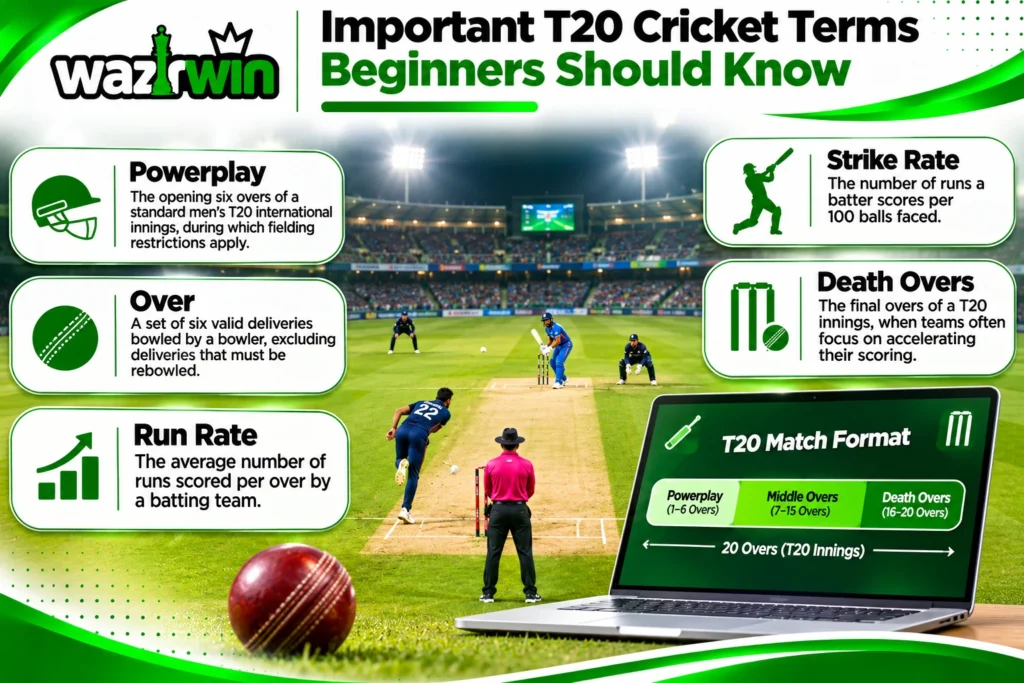
Understanding the basic terms of cricket will enable you to read match reports, listen to cricket commentary and understand the scorecards.
Powerplay: The initial number of overs in a limited-overs match where there are specific restrictions on the field for the bowling team.
Over: This is the set of six deliveries which are bowled by a single bowler. The bowler’s Over is brought to an end by completion of the six valid deliveries (not counting wides and no-balls).
Run Rate: Average runs per over.
Required Run Rate: The required run rate for the chasing side to reach their target in the remaining overs.
Wicket: The wickets of the batsmen or the stumps, depending on how one uses the term.
Boundary: A way in which teams score. If a ball is hit beyond the boundary of the field then this is scored as four for a ball that has hit the ground before going past the boundary of play and a six if it travels over the boundary of play without touching ground inside the field.
Dot Ball: A legal delivery that results in no runs being scored.
Death Overs: The last overs of a limited overs match. In these the team typically tries to increase their scoring rate.
Super Over: A method of deciding a match when scores are level to end a match in a limited overs competition.
Factors That Influence a T20 Match
A lot can happen in a short match of 20 overs, and all these cricket-related factors could have a significant impact on both teams.
Pitch Conditions
The pitch can behave differently for a fast bowler than for a spinner, and even more so for a batsman. The behavior of a pitch can change in the course of a match, not only as a result of the design of the cricket field but also as a result of the weather.
Weather Conditions
Interruptions from rain, as well as changes in humidity, wind and temperature, may all affect playing conditions and also, perhaps, reduce the number of overs to be bowled.
Batting Depth
In cricket a team’s ‘batting depth’ is a measure of the number of good batsmen in a side. So, if a team loses early wickets a side with good depth can start to score well again.
Bowling Variety
A team typically has a mix of fast bowlers, medium pacers and spinners. This allows the captain of the team to choose the style of bowling that he feels is best suited for the different stages of an innings.
Fielding Performance
Fielding: Catching, boundary reading and throwing all come into play here. Dropping a catch or missing a run out can have a massive impact on the outcome of a short game.
Player Fitness
Much of the action of short form cricket requires quick movements and lots of running between wickets. Therefore, maintaining the fitness of your players and enabling them to recover between matches is crucial in a crowded T20 schedule.
How to Read a T20 Cricket Scorecard
A scorecard is a record of all that happens in a match. To help new users learn most of this information we have listed out a few key terms and their meanings.
| Scorecard Term | Meaning |
| Runs | Total number of runs scored by a batter or team |
| Balls | Number of deliveries faced by a batter |
| Overs | Number of overs bowled by a team or bowler |
| Wickets | Number of batters dismissed |
| Extras | Additional runs awarded through wides, no-balls, byes, and leg-byes |
| Economy Rate | Average number of runs conceded by a bowler per over |
| Strike Rate | Number of runs scored by a batter per 100 balls faced |
| Required Run Rate | Number of runs per over the chasing team needs to score to reach the target |
The score of 180/6 in 20 overs for example reports 180 runs for 6 lost wickets in all 20 overs of a team’s 20-over innings. A scorecard enables you to best assess individual performances. A player who has scored 65 runs for 35 balls made a greater contribution to his team than a player who scored 65 runs for 55 balls. Also the statistics for bowling a ball record how many runs were dismissed by a player and how many wickets he took.
Understanding T20 Cricket Information and Online Terminology
Since information related to T20 Cricket Betting IDs consists of references to information related to cricket scores, cricket match formats, cricket player statistics etc. to online cricket betting information, we have to clearly distinguish between information about cricket and online cricket betting in order to avoid any misleading information that could lead to participation in online cricket matches for real money.
A match guide can provide clarity on:
- The number of overs in a T20 innings.
- The mechanics of the toss.
- The importance of powerplay overs.
- How teams set and chase targets.
- The recording of player statistics.
- The structure of tournament points and qualification systems.
Understanding cricket is your step to greater cricket awareness and we’re happy to share all that with you without you having to invest a single rupee!
Also browse other Cricket and Sports related articles on the WazirWin.
Legal Awareness About Online Money Games in India
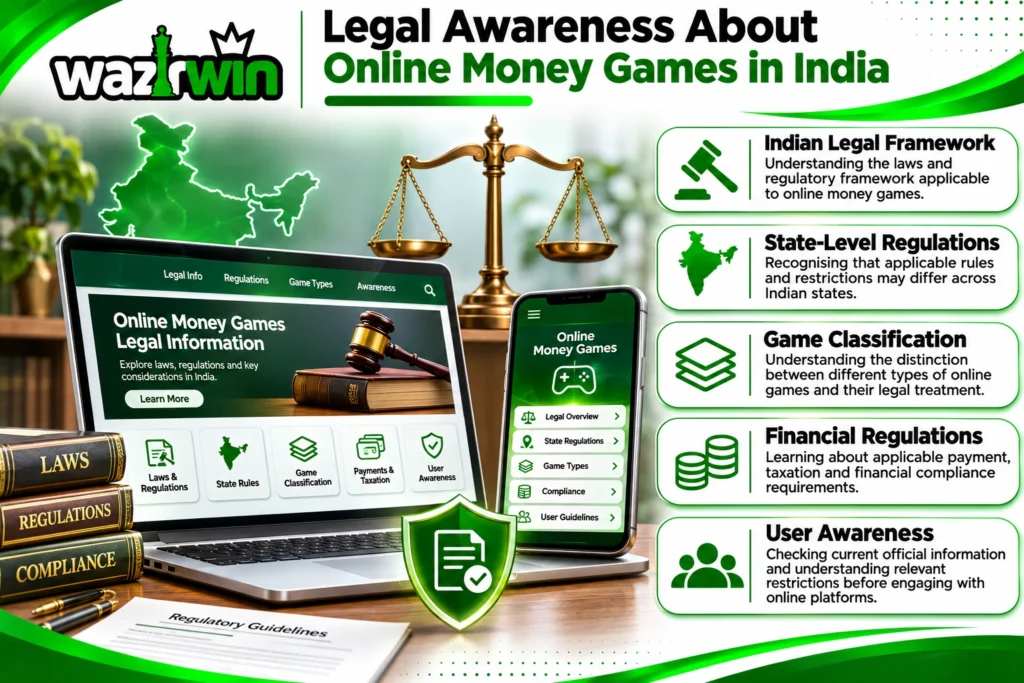
Most services advertising T20 Cricket Betting ID are based overseas and not authorized to offer services within India.
Online money games, whether based on skill, chance or a combination of both have been prohibited under the Promotion and Regulation of Online Gaming Act, 2025. The Promotion and Regulation of Online Gaming Rules, 2026 which came into effect on 1st May, 2026 also deals with issues like offering, facilitating, promoting online money games and financial dealings etc. in relation to prohibited online money games.
For example, instead of going for an online T20 Cricket Betting ID, you can utilize your leisure time to update yourself on latest scores, read T20 cricket match reports, learn the rules of T20 cricket and many more.
For trusted information on gaming laws in India kindly refer to Government websites rather than advertisements by gaming platforms on account opening.
Final Thoughts
In recent years, T20 cricket has grown into a key area of cricket, delivering a unique mix of short cricket and thrilling competition. With a 20-over format, powerplay restrictions, bowl limitations and a single innings of cricket per team, it differs from both the longer-form 50-over ODIs and the extended 5-day Test Matches.
For new followers of the game, first learning about the T20 Cricket Format is key to learning scorecards, match rules, a tournament’s structure and a player’s performance etc. Once you have a good grasp of all of that, it’s relatively easy to follow domestic leagues and internationals played as T20 matches.
It’s also very important to make a clear distinction between knowing more about the game of cricket and playing online money games. The knowledge of a sport must not be mixed up with the online services for placing bets and their legality.
Frequently Asked Questions
1. What is the T20 Cricket Format?
This format of cricket is an adaptation of cricket and in a T20 cricket match, each team is allowed to play one innings and is restricted to 20 overs.
2. How many overs are played in a T20 match?
An average T20 cricket match lasts for 40 overs with 20 overs from each team provided that no team gets bowled out. However in most cases a team gets bowled out even before all the overs get finished.
3. How many players are there in a T20 cricket team?
The cricket team consists of 11 players in the field and other players which can be substituted according to rules of respective matches/tournaments.
4. What are powerplay overs in T20 cricket?
The first 6 overs of an innings in T20 cricket are known as the powerplay. During this time there are specific restrictions to the field and the number of fielders that can be placed within a 30 yard circle, for example there can be no more than 2 fielders outside this circle.
5. In T20 cricket how many overs can a single bowler bowl?
In a 20-over game the typical maximum number of overs to be bowled by any single player would be 4 overs but can vary should an innings be cut short in some manner.
6. How does T20 cricket differ from ODI cricket?
The main difference between T20 Cricket Matches and One Day Internationals (ODIs) is the number of Overs a team can face in a match. In T20 Cricket a team can face a maximum of 20 Overs whereas in an ODI a team can face a maximum of 50 Overs.
7. How long does a T20 international match usually last?
A T20 International match typically lasts for about 3 hours. But if there’s a rain interval or some other interruption, it could take more than that.
8. Is the score tied in case of a T20 Cricket Match?
Tied matches are resolved by a Super Over unless the tournament has specified an alternative way to decide a tie. The playing conditions for the tournament will define the procedure to be used to decide a tie for a match.
9. What is the required run rate in T20 cricket?
The Required Run Rate is the average run rate that the 2nd team needs to score in order to win the match with the overs they have left in hand.
10. Is an online T20 Cricket Betting ID same as a cricket scorecard account for online T20 Cricket score?
That’s a wrong notion. Account with cricket scorecard or sports-information online account provides scores, statistics and other information related to the match whereas an account with online T20 Cricket Betting ID refers to online betting services i.e. different category under India’s online gaming regulations that prohibit money games and related services.