
India vs New Zealand 1st T20I Review 2026 up online. The match was a high scoring encounter that ended in a comprehensive win for India as they chased 226 runs for a victory and won the match by 4 wickets to take a 1-0 lead in the 5-match series.
In the end New Zealand managed to score 225/4 in their 20 overs with Glenn Phillips scoring an unbeaten 82 off 40 deliveries in the match. The other notable scorer for the Black Caps was Finn Allen scoring 45 off 24 deliveries and Bevon Jacobs scoring 31 off 16 deliveries for New Zealand.
The two Indian batsmen in the opening combination played aggressive cricket. While Sanju Samson scored 67 runs off 33 deliveries, Abhishek Sharma scored 29 runs in 12 deliveries. Later in the innings after some wickets fell in the middle, Shreyas Iyer scored 42 runs of 28 deliveries and Naman Dhir scored 42 runs off 15 deliveries to take India home in the end.
The match was a testament to India’s strong batting line-up and finishing abilities but also exposed areas of improvement for the bowlers as NZ managed to notch up 220 plus with four wickets in hand.
Table of Contents
India vs New Zealand 1st T20I: Match Summary
| Match Detail | Information |
| Match | 1st T20 International |
| Date | October 22, 2026 |
| Venue | Hagley Oval, Christchurch |
| New Zealand | 225/4 in 20 overs |
| India | 230/6 in 19.4 overs |
| Result | India won by 4 wickets |
| T20I series score | India lead 1–0 |
India needed 226 runs for a win in the match and achieved the run in 19.4 overs. The chase to achieve the large total was through aggressive start, good stabilizing phase of middle order and excellent finisher of the team.
New Zealand Batting Review: Glenn Phillips Leads the Scoring
New Zealand set up their 20 over innings with the intent of attacking cricket with several players contributing to the effort. Glenn Phillips was exceptional finishing 82 from 40 daughters at a strike rate of 205 to remain not out. He hit 8 fours and 3 sixes in his aggregate.
Finn Allen scored 45 in 24 deliveries to help kick-start the New Zealand innings and get off to the perfect start. He was supported by the rest of the team, with Tim Seifert scoring 24 off 17 deliveries and Daryl Mitchell scoring 28 of his 19 deliveries.
Bevon Jacobs scored 31 off 16 deliveries in the six-over innings before being run out of the ground. Bevon and Phillips combined for a 73-run partnership for the fourth wicket in the six-over innings to help New Zealand score a good total at the end.
Key New Zealand Batting Performances
| Batter | Runs | Balls |
| Tim Seifert | 24 | 17 |
| Finn Allen | 45 | 24 |
| Daryl Mitchell | 28 | 19 |
| Glenn Phillips | 82* | 40 |
| Bevon Jacobs | 31 | 16 |
| Michael Bracewell | 7* | 6 |
Aggressive action from Phillips when 82* and Allen 7* in the first few overs when New Zealand were trying to avoid a slow score to post a large total for India to try and chase.
In the end 225 was not enough for the Kiwis and the Indian batsmen scored at a good rate to score in the end and complete the chase.
India’s Bowling Performance: What Went Wrong?
While New Zealand’s bowling had looked capable of restricting India’s scoring rate to around 225, in reality the hosts scored 225/4 and India went in to the chase to a required rate of 11.3 runs per over from the onset.
Bhuvneshwar conceded 49 runs in his four overs without taking a wicket. Arshdeep, Mayank and Axar all claimed one wicket each but the New Zealand batsmen were still scoring freely.
India’s Bowling Figures
| Bowler | Overs | Runs | Wickets |
| Bhuvneshwar Kumar | 4 | 49 | 0 |
| Arshdeep Singh | 4 | 45 | 1 |
| Mayank Yadav | 4 | 40 | 1 |
| Axar Patel | 4 | 51 | 1 |
| Nitish Kumar Reddy | 4 | 40 | 0 |
Figure 40 also highlights the difficulty the Indian bowling had in preventing boundaries for the New Zealand batsmen and the inability to stem the flow of runs to allow the innings to slow down.
India need to review their approach to bowling lengths, fielding positions and in particular execution in the middle over and death over periods. With a very aggressive batting unit, one expensive over could make the required run chase very difficult.
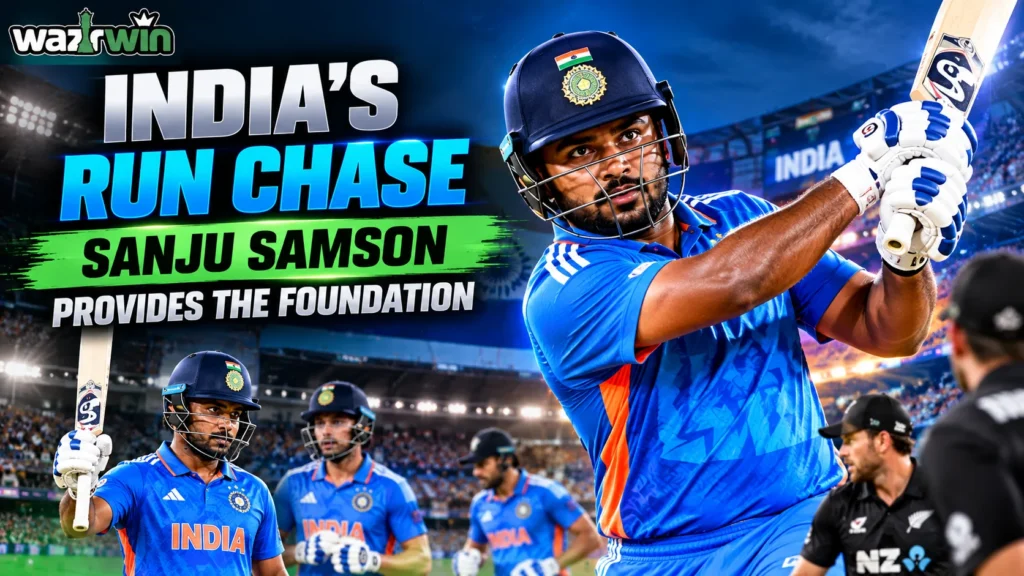
India’s Run Chase: Sanju Samson Provides the Foundation
Sanju Samson scored 67 runs off 33 deliveries. The aggressive wicket-keeper batsman smacked 8 fours and 4 sixes. He was very aggregative and helped India get off to a flying start. His aggressive innings helped to create a large impact in the match early on.
Abhishek Sharma scored 29 runs from 12 deliveries. Thus, Indian openers scored 93+ runs in less than six overs and helped the team to gain a good start to the match and relief from the pressure of chasing a large total.
New Zealand fought back in the middle overs. Abhishek Sharma was dismissed by Michael Bracewell on the penultimate delivery of the powerplay and Samson, Tilak Varma and Ishan Kishan all followed in the next few overs to give the hosts a chance to get back into the match.
Shreyas Iyer scored 42 runs from 28 balls as India slowly kept the pace of required run rate to win. Axar Patel scored 24 runs off 14 balls followed by Naman Dhir who remained not out.
Key Indian Batting Performances
| Batter | Runs | Balls |
| Abhishek Sharma | 29 | 12 |
| Sanju Samson | 67 | 33 |
| Shreyas Iyer | 42 | 28 |
| Axar Patel | 24 | 14 |
| Naman Dhir | 42* | 15 |
While Samson’s exceptional innings in the early stages of the match provided India with the perfect momentum, subsequent batsmen had to deliver in order to guide their side to victory. Iyer formed a productive partnership with Samson to stabilize India’s innings while, later in the match, Dhir delivered the much required shot-making to ensure a successful outcome for the team.
Naman Dhir’s Finishing Knock Changes the Game
Naman Dhir played an important innings of 42* off 15 deliveries to help India win the match. His strike rate of 280 helped maintain the required rate of the innings as it entered the crunch stage after Samson’s dismissal.
Dhir’s aggressive play was required to prevent the required rate to climb further, after wickets fell in the middle and the partnership of Samson and Abhishek came to an end. Dhir’s runs were crucial in closing the gap between the required runs and the remaining number of overs.
Naman Dhir made the partnership with Iyer work well for India in that phase and helped the team regain momentum. Dhir then ensured that the team won with a 6 off the final over of the match and closed the match with two deliveries to spare.
That is how a good start is created but also how late order can finish off the job in a 20 over match. An ideal 20 over cricket match requires all players to fire on all cylinders.
Read more cricket-related sports posts and articles on the Wazirwin blog.
New Zealand Bowling Review: Why the Target Was Not Enough
Despite the New Zealand bowling unit accounting for six wickets, the total of 200 or so was not enough to win the match. Michael Bracewell and Mitchell Santner claimed two wickets each with Lockie Ferguson also bagging a couple.
Bracewell conceded 37 runs in his four overs while Santner and Ferguson conceded 39 and 34 runs respectively. Even though the New Zealand bowlers got wickets, India’s scoring rate was enough for the team to complete the chase.
Although New Zealand had tried to make it a closer match by removing some of India’s big hitters, Iyer and Dhir’s late partnership was enough to seal a 4 wicket win for India in the end.
New Zealand will look to better the death-over bowling and to prevent large amounts of boundaries in the next match as they look to defend a large total.
Key Turning Points of the Match
The opening partnership of Samson and Abhishek which put together 93 runs in less than six overs and had set the platform for aggressive scoring to help India maintain a high required run rate.
New Zealand’s middle-over wickets fall: Creating pressure on India to try and kick-on to win the game.
Iyer scored 42 runs from 28 balls while others scored in their respective comeos to set up the last section of the chase for India.
Dhir’s late acceleration: He had scored an undefeated 42 off 15 balls to accelerate the score to help India win with two balls to spare.
This is how the match remained interesting even after Samson and Abhishek had provided a brilliant start to the Indian innings and New Zealand had piled up a huge score.
What India Did Well and What Needs Improvement
Firstly, India’s batting was very good to start off with. The Samson – Abhishek partnership set off to a great start to the match and continued to build momentum in their partnership. Iyer stemmed the tide of wickets and scored in good time to ensure a solid foundation for the late Dhir to score the requisite runs at a good pace in order to complete the match in 2 overs with 2 deliveries to spare.
The bowling however had little room for error having allowed 225 runs in 20 overs. India would look to improve on this area and look to contain the number of boundaries as well as maintain a higher standard of execution in the middle overs as well as in the death overs.
The batting for New Zealand played well throughout their 20 overs with Glenn Phillips and Allen being the standout performers, scoring the majority of the runs. Their bowling was also effective, taking 6 wickets, restricting India on several occasions. However, they struggled to stop the late rush of runs by India’s top order.
Both teams will have to work on some areas before their next encounter. India would look to improve their bowling in terms of giving less runs and NZ would look to improve their bowling in terms of restricting runs and taking wickets.
What the Result Means for the T20I Series
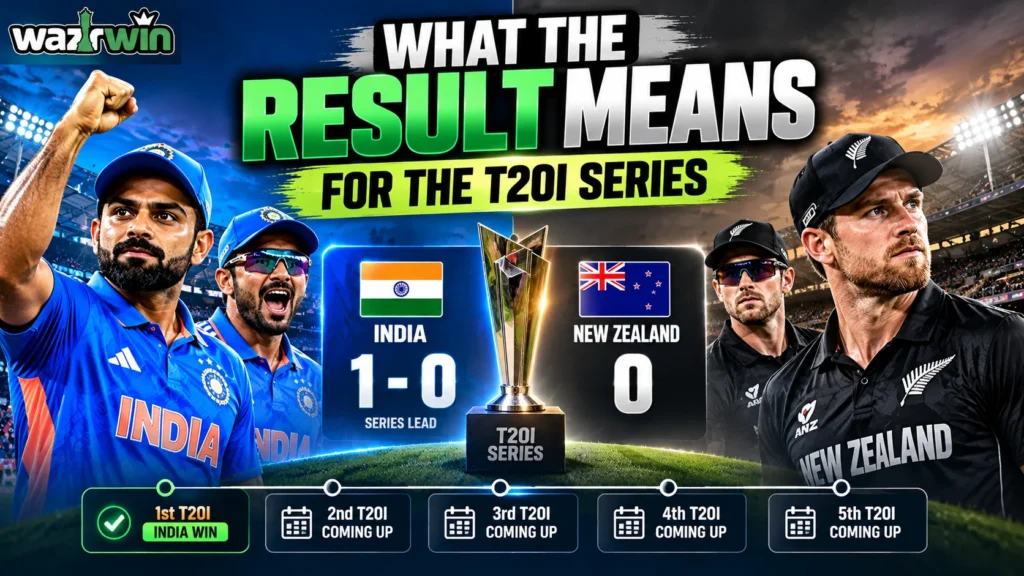
India secured an early edge in the five-match T20I series after claiming a four-wicket win to take an 1-0 lead, with four more matches scheduled to be played.
India will look to keep their work in the batting department intact in the next match. The bowlers though would look to address the number of runs conceded to the New Zealanders in the first innings and also look for areas to plug to prevent a repeat of the 226 runs that New Zealand scored. The Kiwis on the other hand would look to fine-tune their bowling strategy and even fine-tune their field placements to stifle any late flurry of wickets to see India suffer a similar fate.
The India vs New Zealand 1st T20I Review is furthermore of great value for the analysis of teams under pressure. Although a large total can make a successful chase very difficult for the opposing team, this does not necessarily mean that it will win the match if the other team has sufficient depth of their batsmen and keeps a sufficient scoring rate.
Readers interested in learning more about Online Cricket ID terminology and account-related information can refer to Wazirwin’s guide on the subject. Remember to read the terms & conditions of any online service you intend to use, understand their privacy policy and verify their legitimacy to ensure that you are using it in full compliance with all applicable laws in your region.
Conclusion
India got off to the perfect start in the 5-match series with a hard fought 4-wicket win and a defendable total of 226/6 on the small Hagley Oval. Glenn Phillips top scored for New Zealand with an unbeaten 82 off just 40 deliveries including 8 fours and 3 sixes. Other important contributions were made by Finn Allen (41), Daryl Mitchell (39) and Bevon Jacobs (22*).
This India scorecard highlighted the importance of a long batting line-up. The Sanju Samson-led India came down to the crease and enjoyed three fruitful innings, plus one maiden 42 from Krishan Dhir, which continued the India scoring rate after the wickets of three of the most important batsmen, including Shreyas Iyer (42).
After winning the first match, it’s now India’s bowling that needs to fire in the next match. The New Zealand team, on the other hand, will be looking to improve their bowling and find ways to defend huge totals.
Explore More Cricket and Gaming Topics
Explore these related Wazirwin articles for more cricket and gaming information:
- Online Cricket ID – Get to know cricket ID terminology and account-related information in this article.
- Wazirwin blog – Find more cricket previews, match reports and gaming content.
Frequently Asked Questions (FAQs)
1. Who won the India vs New Zealand 1st T20I on October 22, 2026?
India won the first T20I match by 4 wickets to go 1-0 up in the 5 match series. India chased down a total of 225/4 in 20 overs to win the match in 19.4 overs.
2. What was New Zealand’s final score?
New Zealand were 225/4 in 20 overs. That meant India had to get 226 runs in the match.
3. How many runs did Glenn Phillips score?
Glenn Phillips scored an unbeaten 82 from 40 balls for New Zealand including 8 fours and 3 sixes.
4. How many runs did Sanju Samson score?
Sanju Samson made 67 off 33 delivery including 8 fours and 4 sixes.
5. How did Naman Dhir perform in the match?
Naman Dhir ended the match in style with a six as he remained not out on 42 off 15 balls.
6. What was India’s final score?
India finished at 230/6 in 19.4 overs while chasing 226.
7. Who were New Zealand’s leading wicket-takers?
Michael Bracewell and Mitchell Santner picked up two wickets each, while Lockie Ferguson was also successful in picking up a wicket.
8. What is India’s position in the T20I series?
India leads the 5 match T20I series 1-0 after winning the Christchurch match.
9. What were the main reasons for India’s victory?
Samson’s scorching start to the innings was backed up by Iyer’s solid contribution in the middle followed by Dhir’s blows towards the end which ensured that India maintained a required run rate to complete their chase.
10. Where can readers find more cricket-related information?
More cricket and gaming information, including match reports and platform reviews, is available on the Wazirwin blog.