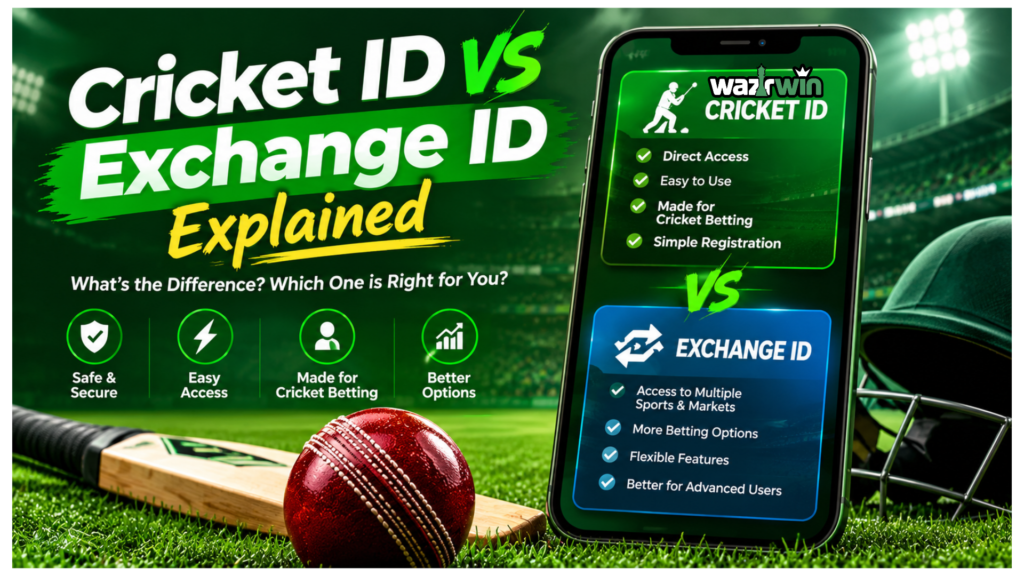
Somebody in a cricket group says, “Get an exchange ID; the rates are better.” Somebody else says, “Just take a normal cricket ID; it’s simpler.” Both sound completely sure of themselves, and both are using words they’ve never actually defined. Nobody asks what the difference is, so everybody nods and moves on.
This guide, Cricket ID vs Exchange ID Explained, slows that conversation down. We’ll go through the definitions, the maths and the jargon in plain language, with rupee examples you can check on a calculator. It is an explainer, nothing more. I haven’t verified any platform, seller or agent, and nothing here is a recommendation or a promise of returns, because no result is ever certain.
Table of Contents
What a cricket ID is
It’s slang, plain and simple. “ID” is what people call a login to a platform where money is placed on cricket matches. The “ID” really means the username and password you’re handed. It is not a term and no regulator gives out anything, with that name.
That unclear meaning is part of the problem. One person might mean a login on a traditional betting site. Another might mean an account on an exchange. A third might mean something that doesn’t exist at all, sold by someone who only wanted your deposit.
A login by itself gives you no extra information and no better odds. It doesn’t make any result more predictable. All it does is open the door to a platform’s markets, and everything that happens after the door opens depends on who runs the platform and how they treat your money.
What an exchange ID is
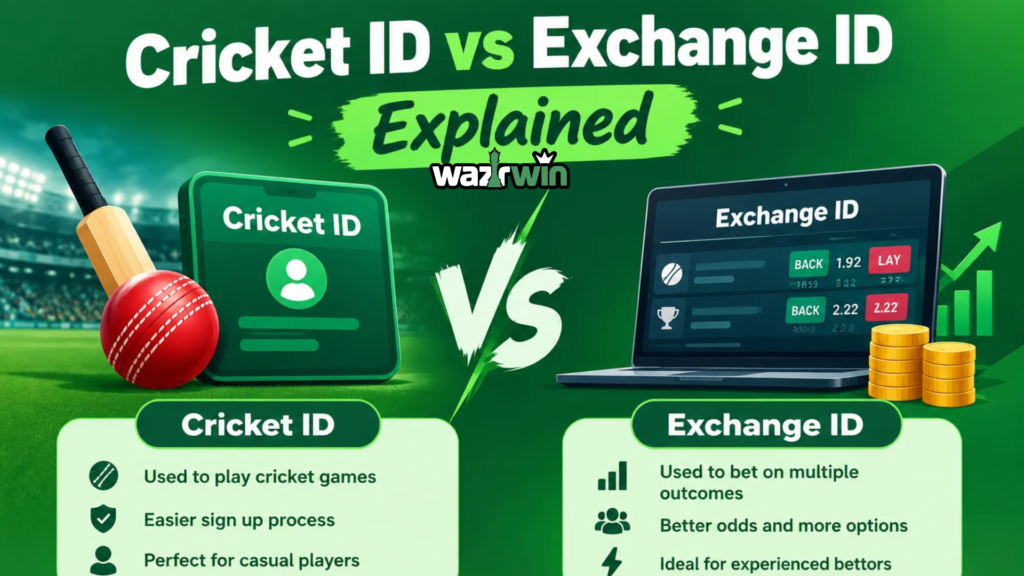
An exchange ID is a login to a betting exchange. Instead of taking the other side of your bet, the platform matches you with another user who thinks the opposite. If you believe a team will win, you get paired with someone who believes it won’t. The platform then earns a commission, usually charged on your net winnings.
Picture a market stall. On a normal betting site, the stall owner sets the price and trades with you every single time. On an exchange, the owner only introduces buyers to sellers and charges a small fee for the introduction. The prices are determined by the members operating in the market and not the owner.
Therefore, all exchange ID numbers are ID numbers, but not all cricket-ID numbers are exchange ID numbers.
The core difference
Everything in Cricket-ID vs Exchange ID Explained comes down to one question: who is on the other side of your bet?
- Traditional platform: you bet against the platform. It sets the odds and tucks its margin inside them.
- Exchange: you bet against other users. Odds come from the market, and the platform charges a commission.
Neither type is safe or unsafe just because of what it is. Safety depends on the company behind it, how it handles your funds and how it processes withdrawals. A well-run site of either kind beats a badly run one every time. And a login bought through a stranger is risky whichever kind it turns out to be.
How odds work
The decimal format gives the amount won on a ₹1 bet including the stake. When you bet ₹1,000 at 3.00, the win amount is ₹3,000. That’s ₹2,000 profit plus your own ₹1,000 back.
Odds also hide a probability. Divide 1 by the odds, and 1 ÷ 3.00 gives about 33.3%. That’s the chance the price is asking you to believe in. If you honestly think the real chance is higher, people call it value. If you’re only guessing, well, it’s a guess, and it’s worth being honest with yourself about which one it is.
| Decimal odds | Implied probability | Return on ₹1,000 stake |
| 1.50 | 66.7% | ₹1,500 |
| 2.00 | 50.0% | ₹2,000 |
| 3.00 | 33.3% | ₹3,000 |
| 5.00 | 20.0% | ₹5,000 |
Notice how the return grows as the implied chance shrinks. Longer odds feel exciting precisely because they win less often. That’s not a trick, it’s just arithmetic, but it’s the arithmetic most people skip.
The built-in margin
Here’s the part that surprises people. On a traditional platform, the cost sits inside the odds, where you can’t see it unless you do a little sum.
Take a two-way match with team A at 1.80 and team B at 2.10. The implied chances are 55.6% and 47.6%. Add them and you get 103.2%. A fair market would total exactly 100%, so that extra 3.2% is the platform’s cut, taken before the first ball is bowled.
| Outcome | Odds | Implied chance |
| Team A | 1.80 | 55.6% |
| Team B | 2.10 | 47.6% |
| Total | 103.2% |
It appears to be small but it keeps happening every time you place a bet. With more than a hundred bets, the small fee can become quite substantial. Exchanges tend to provide closer pricing but the only catch is that they have commissions too. Backing and laying
Backing means betting that something will happen, like a team winning. Your worst case is losing your stake. Laying is the reverse: you bet that it won’t happen, so you act like the bookmaker for that bet. Back and lay betting is what makes an exchange feel different, and it changes your worst case completely.
When you lay, your maximum loss is your liability, not your stake. Liability is the backer’s stake multiplied by (odds − 1). The team is laid for 3.00 with an investment of ₹1,000. You will be liable for ₹1,000 times 2 that makes ₹2,000. If the team loses, you get ₹1,000. However, if the team wins, you will owe ₹2,000. (Illustrative figures.)
| Your bet | Team wins | Team loses |
| Back (₹1,000 stake) | +₹2,000 | −₹1,000 |
| Lay (₹1,000 backer stake) | −₹2,000 | +₹1,000 |
Plenty of beginners read “stake ₹1,000” and assume that’s the most they can lose. On a lay bet it isn’t. Liability climbs quickly as the odds get longer:
| Odds | Liability on ₹1,000 backer stake |
| 2.00 | ₹1,000 |
| 3.00 | ₹2,000 |
| 5.00 | ₹4,000 |
| 10.00 | ₹9,000 |
So before you confirm any lay bet, read the liability figure out loud. If the number makes your stomach drop, that’s information.
Commission, worked through
Consider that you placed your stake at 3.00 in one thousand rupees on a particular team which won. Total profit is two thousand rupees. If the exchange takes 5% commission on winnings it keeps one hundred rupees and you take home one thousand nine hundred rupees. If the bet loses you lose one thousand rupees. Pay no commission at all. (The 5% is an example. Each platform has its rate and should show it.)
| Bet | Result | Gross | Commission (5%) | Net |
| Back ₹1,000 | Wins | +₹2,000 | ₹100 | +₹1,900 |
| Back ₹1,000 | Loses | −₹1,000 | ₹0 | −₹1,000 |
| Lay (₹1,000 backer stake) | Wins | +₹1,000 | ₹50 | +₹950 |
| Lay (₹1,000 backer stake) | Loses | −₹2,000 | ₹0 | −₹2,000 |
This is also the everyday test in Cricket-ID vs Exchange ID Explained: on a traditional site, look at the odds to find the cost. On an exchange, look at the commission rate. If you can’t find it written down, that’s your first warning, because you can’t judge a platform’s cost without it.
Matching and liquidity
An exchange only works if someone is willing to take the other side. When few users do, part of your bet, or all of it, can sit unmatched, or you might end up with worse odds than you hoped for. That’s called thin liquidity.
Big matches usually have deep markets, with plenty of people on both sides. Smaller matches can feel like an empty shop. A traditional platform accepts the bet itself, so matching never comes up there. It’s a quiet reason some beginners find a normal login less stressful: you bet, it’s accepted, done.
One match, two platforms
Let’s put the same match through both models, using illustrative numbers. Suppose you fancy team B and want to put ₹1,000 on it.
On a traditional platform, team B is priced at 2.10. If it wins, you collect ₹2,100, which is ₹1,100 profit. The margin is already inside that price, so you pay no separate fee.
On an exchange, another user is willing to take the other side at 2.20. If you back team B at 2.20 and it wins, gross profit is ₹1,200. With 5% commission on net winnings, the exchange keeps ₹60, so you net ₹1,140. In this example the exchange comes out a little ahead.
Change the numbers a bit, though, and it can flip. With the exchange rate of 2.12, you would get a gross profit of ₹1,120, commission of ₹56, resulting in net profit of ₹1,064 that is marginally inferior to the classical ₹1,100. Neither side wins every time. What matters is comparing the final number after fees on the specific bet in front of you, not trusting a slogan like “better rates.”
Side-by-side comparison
Here’s the whole Cricket-ID vs Exchange ID Explained comparison in one place.
| Feature | Traditional cricket ID | Exchange ID |
| You bet against | The platform | Other users |
| Where odds come from | Set by the platform | Set by user demand and supply |
| How the platform earns | Margin inside the odds | Commission on net winnings |
| Types of bet | Mostly backing | Backing and laying |
| Maximum loss | Usually your stake | Stake (back) or liability (lay) |
| Matching | Not needed | Depends on liquidity |
| Price changes | Platform adjusts odds | Market moves with every bet |
| Learning curve | Lower | Higher |
| Reseller risk | Present | Present |
Look at that last row. Whichever type you pick, buying a login through a middleman adds a layer of risk that has nothing to do with the platform type.
Who ends up using which
In a general sense, individuals gravitate towards the conventional form of login where they select a market, note a price, and place their wager. The decisions are fewer, and the maximum loss on a normal bet is your stake.
Those people who opt for exchanges do so because of the added flexibility that allows them to pick their prices, determine the outcome, or trade their position before the matching process is completed. This added flexibility, however, involves several other elements and poses a challenge to learn.
Neither choice is a badge of experience. Plenty of people lose money on exchanges because they used tools they didn’t fully understand, and plenty keep their losses small on basic platforms because they stuck to small stakes and clear limits.
Where your money goes
Follow one deposit. You send ₹1,000. If you pay on the platform’s own payment page, the money goes to a registered business, a receipt is created and your bank can trace it. If you pay a person’s UPI ID instead, the money lands with an individual, often with no receipt and a name that doesn’t match anybody you’ve been talking to.
Then there’s the balance on your screen. That number isn’t money in your bank. It’s a record held by whoever runs the system, and they decide whether it can leave. A big balance proves nothing about the platform. Only a successful withdrawal shows that money can come back out.
On an exchange, there’s one more step: the commission is deducted from your net winnings. The percentage should be written in the terms.
Resellers and middlemen
Many people never deal with a platform directly. They deal with a seller who hands out logins and collects deposits. These sellers go by different names, such as agent, dealer, manager or panel owner, but the pattern is much the same.
A reseller typically holds logins on a panel, sends you one, takes your deposit and passes part of it up the chain. They may earn a cut of your deposits, and sometimes of your losses. That isn’t automatically a scam, but it changes whose interests line up with yours.
If your withdrawal gets stuck, the platform can say it never took your money, and the reseller can go silent. You’re left with a chat history and nobody accountable. It’s the most common way people lose money, and it happens with basic logins and exchange logins alike.
Before making payments, you should ask a few straightforward questions. Who runs the website? Where do I register? Who receives my money? What are the withdrawal rules? What happens if a withdrawal gets stuck? A seller who can’t answer these cleanly isn’t worth your money, however friendly the chat feels.
A short glossary
- Stake: the amount you put on a bet.
- Liability: the most you can lose on a lay bet.
- Commission: the fee an exchange takes from net winnings.
- Margin (overround): the extra percentage built into a set of odds.
- Liquidity: how much money is available to match your bet.
- Implied probability: 1 divided by decimal odds.
- Unmatched bet: a bet, or part of one, that found no counterparty.
- Panel: a back-end system a reseller uses to create and manage logins.
How to evaluate any platform
No matter which sort you’re considering, there are some simple facts that are checkable and teach you more than any ad can. Check to find if there’s a company name, address, and grievance contact within the app, not only on a banner. Mere chat room presence doesn’t count.
Check that fees, commission, limits and withdrawal rules are written in plain language. On an exchange, check the commission rate and how liability is shown before you confirm a lay bet. Go through the website URL letter by letter since duplicates always tend to modify just one letter of the ending, such as .in, .io, or .com.
Afterwards, type in the website name with “complaint” or “withdrawal issue,” then look for patterns instead of one angry review. One review could simply be incorrect. Fifty such reviews would constitute a pattern.
That applies to WazirWin as much as to any other name. And install apps only from an official website or a trusted store, never from a chat link. A betting app has no reason to want your contacts, SMS or gallery.
The small test
Here’s the habit that protects people more than any review. Put in a little, place a small bet, then try a small withdrawal. Do this with WazirWin or any other name you’re curious about, before anything bigger goes in.
Notice how long the withdrawal takes and how quickly support replies. Notice whether the amount matches what the screen promised. If a “release fee,” “tax” or “verification fee” appears before your own money leaves, stop right there. A balance means nothing until a withdrawal has actually worked.
Red flags that keep repeating
These patterns show up again and again in complaints, so they’re worth memorising:
- A stranger who messages you first. Real businesses don’t chase people in private chats.
- Payment to a personal UPI ID. No company name, no receipt, no way back.
- Pressure to hurry. “Limited IDs left” and “offer ends today” exist to stop you thinking.
- Fees before withdrawal. A “tax” or “release fee” before your own money leaves is a classic trap.
- A request for your OTP or UPI PIN. Real support never needs either.
- Screenshots with no source. Balances and payout receipts are easy to fake.
- Bonus codes in comments or Telegram groups. A code costs nothing to copy or fake. What the poster wants is your click, your number or your OTP.
If two or more appear, step away. You lose nothing by leaving.
Common beginner mistakes
A few errors come up so often they’re worth listing on their own. Assuming a lay bet risks only the stake. Ignoring commission and then wondering why winnings are smaller than expected. Treating a screenshot balance as real cash. Raising the stake after a loss to “get it back.” Paying a person instead of the platform. Skipping the written terms because the chat was friendly.
Almost every one of these comes from moving too fast. The fix is boring: slow down, read the number that applies to the bet in front of you, and keep stakes small enough that a mistake doesn’t hurt.
The legal position in India
India’s online gaming rules changed in 2025, and real-money online games are now heavily restricted. State laws add more differences on top, and both rules and enforcement keep shifting. So a platform a seller recommends may not be allowed to operate where you live.
That matters for both types of login. If something goes wrong with an activity that isn’t permitted, you may have far less recourse, because a complaint about it is hard to pursue. I’m not a lawyer, and nothing here is legal advice. Check an official government source or speak to a qualified lawyer before you deposit anything. If you’re unsure, don’t. You must be 18 or older for anything involving money.
Keeping your limits
Whichever login you use, the same personal rules protect you.
- Use only money you can afford to lose, never rent, bills or EMIs.
- Keep each bet to about 1 to 2% of your budget, which is ₹10 to ₹20 on ₹1,000.
- Decide your stopping point before the match starts, and set a timer.
- Don’t chase losses. ₹300 has a habit of quietly becoming ₹3,000.
- Take extra care with lay bets, because your loss can be larger than your stake.
Pay attention to how you feel while playing. If you’re stressed, trying to fix a money problem or staying longer than planned, close the app. If stopping feels hard, take a break and talk to someone you trust.
If you already paid the wrong person
Speed matters more than anything here.
- Stop paying. However firmly someone says the next payment will “release” your balance, don’t send another rupee.
- Call your bank straight away. Ask them to flag or stop the transfer. Banks can sometimes help if you report quickly, though payments to individuals are harder to dispute than payments to registered businesses.
- Save everything. Keep every chat, screenshot and transaction ID.
- Report it. Use the national cybercrime portal or call 1930, ideally the same day.
- Secure your accounts. Change passwords, starting with your email, and log out of other devices.
Don’t pay any “recovery agent” who contacts you afterwards. They’re often the same people, or their partners.
Final thoughts
A cricket-ID is the general word for a login, and an exchange ID is one type of it. The real differences come down to who takes the other side, where the cost sits (margin or commission) and how much you can lose on a single bet. Once odds, liability and commission make sense, any market gets easier to read and far fewer things catch you off guard.
The bigger risks never change, though. A login is only as trustworthy as the company behind it and the person who sold it to you. A large balance means nothing until a withdrawal goes through, and a friendly seller means nothing either, because friendliness is free. Check who runs it, read the terms, test small and never share an OTP. Set your limit first, and leave when you reach it.
18+ only. Gambling involves financial risk. If you’re stressed or betting more than planned, take a break and talk to someone you trust.
Frequently asked questions
1. What is the main difference between a cricket ID and an exchange ID?
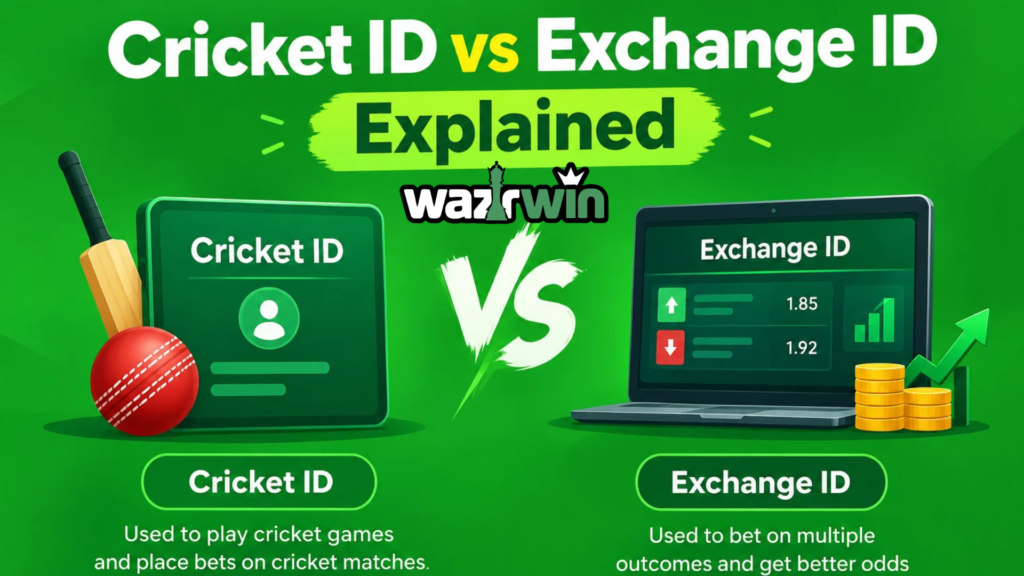
A cricket-ID is the general word for a login. An exchange ID is a type where you bet against other users and the platform earns a commission.
2. What does “lay” mean?
Laying means betting that something will not happen. Your maximum loss is your liability, which can be larger than your stake.
3. How is liability calculated?
Backer’s stake multiplied by (odds − 1). At odds of 3.00 against a ₹1,000 stake, liability is ₹2,000.
4. How does an exchange make money?
Usually through commission on net winnings, which should be written in its terms.
5. Is an exchange safer than a traditional site?
Not automatically. Safety depends on the operator and how it handles withdrawals, and exchanges add risks like lay liability and unmatched bets.
6. Why do sellers ask for payment to a personal UPI ID?
A personal account leaves no company record and is hard to trace or dispute. A genuine platform takes payment on its own payment page.
7. How do I check a platform?
Check the company details, grievance contact, written terms and withdrawal rules. If you’re looking at WazirWin or any other name, also search it with “complaint” or “withdrawal problem,” and test a small withdrawal first.
8. Is online betting legal in India?
It depends on your state and the 2025 national law. Check an official source before you deposit.