The champions league T20 was among the most entertaining international club tournaments in cricket of the time. It gathered successful domestic T20 teams representing different cricketing nations, and provided fans with the chance to witness several of the top teams from both domestic and franchise sides play against each other. The event combines the popularity of T20 cricket, with the international standard, making it something unique and different from the typical calendar for national teams.
For fans of cricket this tournament is significant in T20 history. The information about teams as well as fixtures, outcomes, scorecards as well as major matches continue to draw interest from people looking at earlier tournaments. This article explains details about the tournament’s history, the format, teams participating in unforgettable matches, historic schedule details, scorecards, updates, as well as its general contributions to the growth of modern T20 cricket.
What Is the Champions League T20?
Champions League T20, commonly known as CLT20 It was an internationally-based Twenty20 cricket event that featured top national teams from a variety of nations that play cricket. It was designed in order to bring teams that had won diverse local T20 events together on one stage.
As opposed to international cricket where players represent their nations, CLT20 let players participate for their own domestic or franchise team. It was a unique way to combine teams since a team can comprise world-class players in addition to skilled local cricketers.
The event offered a unique kind of sport for the fans. The fans could enjoy watching teams that usually play in separate national leagues play each other. The event also gave players an opportunity to experience different play methods, conditions, as well as opponents.
It was especially connected to the important T20 leagues like The Indian Premier League, Australia’s Big Bash-related environment, South Africa’s national T20 tournament, and various other well-established cricket tournaments. The qualification process was usually tied to the performance of domestic tournaments.
Table of Contents
History and Evolution of Champions League T20
The Champions League T20 was established in the time in which Twenty20 cricket experienced an explosion in global growth. The domestic T20 leagues were becoming more popular as was the interest in making a tournament where the best teams in these leagues could compete.
The first edition that was officially sanctioned was held in the year 2009. The following years saw the event grow into an event that is well-known in the calendar of cricket. Different teams from various countries introduced various ways of playing T20 cricket. This made the games unpredictable and exciting.
It also served as an essential stage for players. International stars of the past could be faced with new opponents and teammates and newcomers were able to gain experience playing against top-quality opposition.
A number of editions resulted in tightly contested matches and unforgettable individual performances. The tournament was however faced with difficulties as the international T20 scene continued to evolve. There were other franchise events that grew in popularity as domestic calendars got more overcrowded, and sustaining an international club event got more challenging.
The last edition of the tournament was held in 2014. It was later cancelled and there has not been any official CLT20 tournaments from then on.
Champions League T20 Format and Tournament Structure
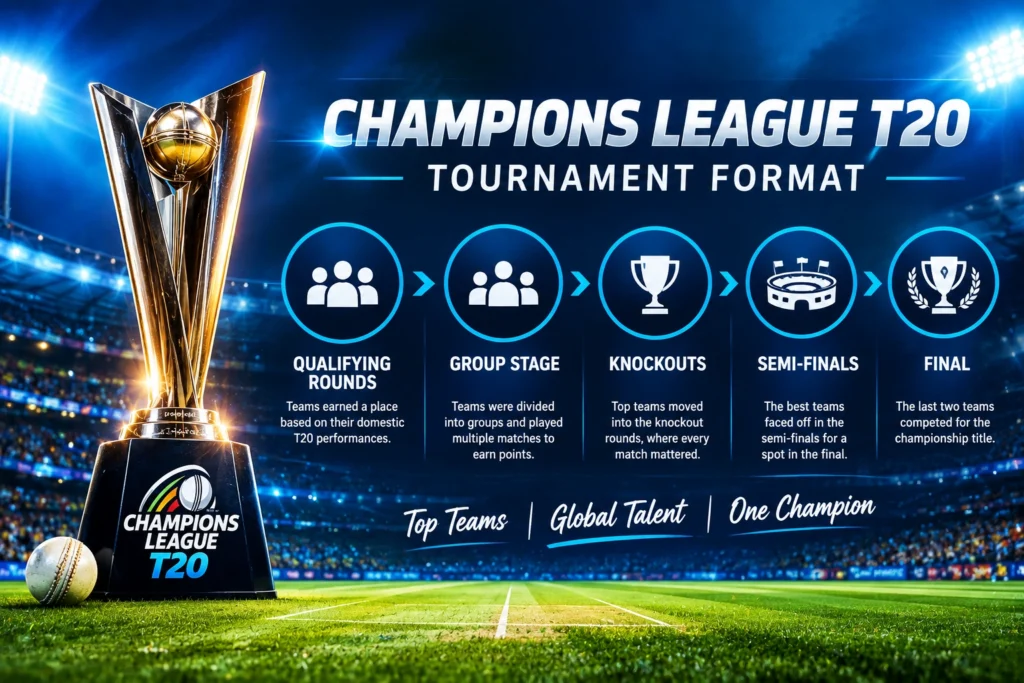
The format for the tournament varied over time, however the tournament generally consisted of an assortment of qualifying rounds, groups matches, qualifying stages, as well as knockout games.
Teams were selected based on their performance during domestic T20 tournaments. Based on the tournament the teams had played qualifying games before they could participate in the main event.
The principal competition typically separated teams up into groups. Teams played multiple games with the aim of earning points according to the results. The teams’ performances at the group stage are crucial as only the best teams would be able to progress into the knockout stage.
The knockout rounds heightened the pressure significantly. One bad performance can cause a team to lose their season, and a team that is successful could advance towards the title.
The semi-finals were one of the most intense matches, and was and then came the final in which the two remaining teams competed for the trophy. The format gave CLT20 an amalgamation of league-style stability as well as knockout-stage energy.
Champions League T20 Teams and Major Performances
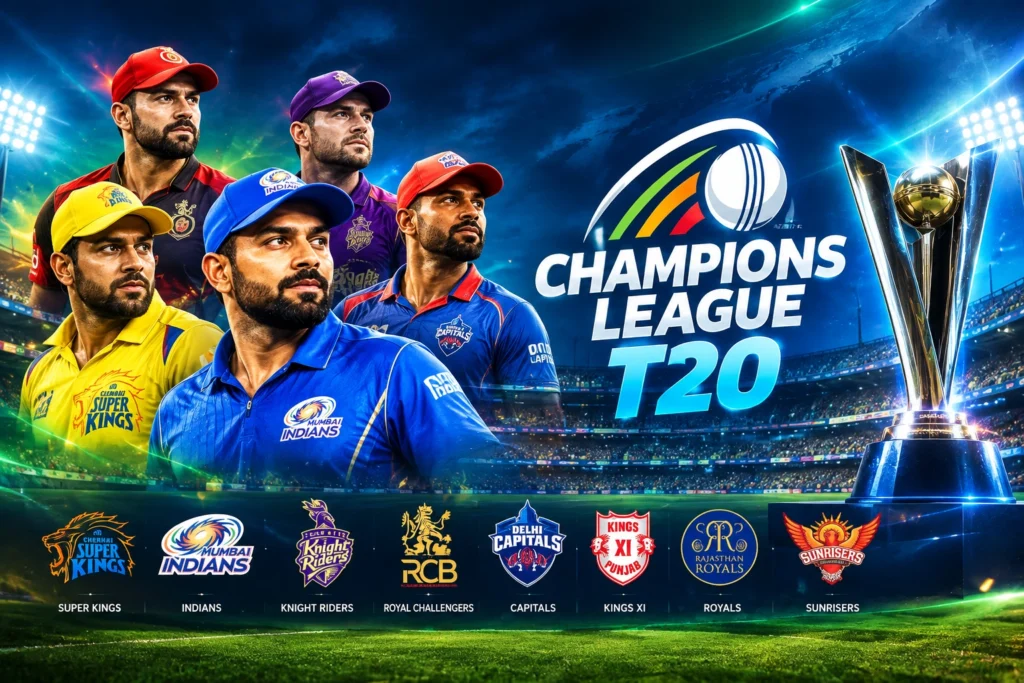
One of the most exciting aspects of the event was the strong collection of local T20 teams. The teams that were successful from different leagues could be qualified and compete with one another in encounters not witnessed elsewhere.
Indian teams were well-known due to the popularity and power in the Indian Premier League. The teams like Chennai Super Kings and Mumbai Indians were prominently featured in the league and had some notable performances.
Others came from tournaments outside of India such as the Australian domestic T20 setting, South Africa, the Caribbean, New Zealand, England and various different cricket areas based on the structure for qualification of the particular season.
International players also added a different aspect. Players who usually played with a team from the opposing side during international cricket might join forces with the identical players within an environment of franchise.
The team compositions were intriguing. A strong batting line-up, skilled quick bowlers, skilled spinners, and a variety of all-rounders frequently played a major role in the final results.
Champions League T20 Matches
The Champions League t20 tournaments offered fans many competitive games. Since teams were from various national competitions, there were frequently significant variations in the play conditions, tactics and team compositions.
The group stage games are crucial for creating momentum. Teams required consistent performances because qualifying for knockout stages was contingent on the position they were within the group. One loss could be important if several teams had a close match.
Knockout games were a lot more tense. The players had less space to make mistakes and the making decisions about the game’s strategy became critical. Captains were required to oversee changing bowling patterns with care, pick the correct batting order and be aware of how the things were going.
A few matches were decided by the last overs, whereas other matches were won by outstanding performance in bowling or batting. T20 cricket is a natural sport that allows rapid shifts in speed which is why CLT20 is no different.
If you are interested in researching historic matches that are currently played, the most useful data is the teams that played, venues results, the toss as well as innings scores, the top runners, wickets played and the final score.
Champions League T20 Schedule
An old-fashioned champions league t20 schedule generally included qualifiers, groups-stage matches, as well as knockout matches. Games were held at different locations, which allowed teams to take on different circumstances.
It was vital to plan the schedule as teams needed to plan transportation, recuperation, as well as preparation, while playing players from various cricket settings. T20 tournaments often have brief breaks between matches, making the rotation of teams and managing players important.
Anyone who is interested in previous editions of the schedule can be helpful to arrange the tournament in a chronological order. The information can reveal who teams competed at the stage of group play as well as when knockout games occurred, and the venues in which major matches were staged.
Since CLT20 has been discontinued following the 2014 edition, search results for schedules typically refer to information from the past and not upcoming games. It is therefore important to differentiate CLT20 schedules that were archived from those from current T20 tournaments.
Champions League T20 Scorecard
A champions league scorecard gives detailed details on what transpired throughout a specific game. It’s one of the most reliable ways to analyze the performances of teams as well as players following a match is over.
The standard scorecard typically includes the total score of each team including wickets lost and overs finished, batsman results, bowling statistics as well as extras and the final score.
The section for batting typically shows the number of runs played by each player ball faced, boundaries as well as strike rate. The bowling section could comprise maidens, overs, wickets, conceded runs and the economy rate.
Other important information could be falls of wickets, alliances, other players and the player of the match’s details.
Reading old scorecards is especially beneficial for those who wish to evaluate the players they played or relive memorable matches. Instead of solely relying on the outcome it is important to know how a game developed, and who made the most contribution.
Champions League T20 News and Updates
While the tournament has ended its existence, champions league t20 information is still relevant in discussions about its past, players and teams, record-breaking performances, and unforgettable performance.
Reports from the past are a great way to help fans better understand the reasons why certain teams participated in the contest, how teams were created, as well as what important changes occurred during every edition. Reports of matches can be beneficial for reviewing close-finishes and memorable individual performances.
Since the event concluded in 2014, fans need to be aware of modern results from searches. Certain websites might use CLT20-related words when discussing historic events however, other results might be referring to non-related current T20 tournaments.
Trustworthy cricket archives, well-established newspapers for sports, as well as official historical records are usually superior sources to verify old tournament data.
Most Memorable Champions League T20 Moments
It was a time of many events that will remain in T20 cricket’s time and again. A strong display of batting was common and top order players often altered the course of an innings in just the space of a couple of minutes.
The bowling performance was equally crucial. Speedy bowlers were able to exploit the initial movement while spinners were often influential in the middle part of the overs. Death bowling was a major element because games could shift quickly during the last overs.
Knockout games are naturally many memorable occasions. Teams faced the pressure of playing high-quality opponents, and any one of their mistakes could have a significant effect on the game’s outcomes.
The final match was particularly important because they were the conclusion of the tournament. To win a championship, teams had to be consistent throughout the tournament before putting themselves under the utmost pressure during the knockout stage.
Why Champions League T20 Was Important for T20 Cricket
The event played a significant contribution to the evolution of international T20 cricket. It brought together domestic matches as well as gave players the opportunity to try their hand at cricket in an environment other than the usual playing environment of their league.
For players from the country, playing with internationally renowned cricketers may provide valuable experiences. It will help them understand how professional players handle stress situations, tactical choices as well as different conditions for a match.
It also highlighted the growing sporting and commercial significance in franchise cricket. The fans became familiar with international players as teams developed more sophisticated methods for recruiting players and building squads.
Another crucial aspect was the global nature of the tournament. Instead of focusing on only national teams, the fans could cheer on local teams playing in a larger arena. This encouraged an interest in clubs and franchise-based T20 cricket.
Many elements that became common in later T20 competitions–international squads, specialist players, tactical matchups, and highly competitive short-format cricket–were already visible during this period.
What Happened to the Champions League T20?
The Champions League T20 was discontinued following the 2014. edition. Many factors were responsible for this tournament’s demise, such as developments in the global T20 scene and the growing amount of franchise and domestic events.
As T20 cricket expanded, cricket calendars became more crowded. The players were more engaged in multiple leagues as well as international obligations, which made it difficult to find a space for another big competition becoming more challenging to manage.
The rise of franchise leagues affected the game. The domestic T20 tournaments became bigger brands as well which gave players the chance to compete across the globe.
While CLT20 was no longer played, its importance to the past remains. CLT20 was an early effort to join successful local T20 teams together to compete in an international club tournament.
How to Follow Historical Champions League T20 Information
People interested in the current tournament are able to look through historical archives of cricket as well as established websites for sports. Different kinds of information need distinct approaches.
To find fixtures, schedules from the past will help you identify times, locations, as well as the teams that are participating. Match databases are helpful for searching for individual games as well as their outcomes.
In relation to player performances, historic scorecards are more detailed than the standard results pages. They may be used for analyzing wickets, runs strikes, strike rate economies rates, partnerships as well as other statistics from matches.
News archives are helpful for getting a better understanding of the larger story of the tournament. They could contain information about squad announcements, team changes news, injury reports report on matches, as well as events.
If you are researching information from old cricket tournaments It is often helpful to examine important stats across trustworthy sources. This is especially important in the case of the records of tournaments which have ceased to be active.
Final Thoughts
The champions league t20 is a significant event in the time of Twenty20 cricket. Through bringing the most successful teams from domestic cricket of different countries together it gave a game which brought international recognition with the thrill of franchise cricket.
While the event has ended its match, participants schedules, teams, and scorecards continue to be interesting for cricket lovers. These historical documents also offer insights into the way T20 cricket evolved into the format that it is now.
If you are interested in watching cricket, looking up historical data as well as exploring the latest gaming and sporting events, opting for a website that has easily accessible information as well as a simple user interface can improve the overall experience and make it simpler. Wazir win is one of the options that players might consider while looking up online entertainment for sports, which is as long as they adhere to the relevant laws and responsible participation.
The success of CLT20 can be traced back to the growth in T20 cricket. CLT20 demonstrated how local teams could draw in international fans and established a precedent which influenced the growing market of the franchise-based game of cricket.
If you are interested in internet-based sports entertainment or cricket-related activities in the present, Wazir win is a second option that you can look into, but users must ensure they are aware of local laws and be responsible when participating.
Frequently Asked Questions
What is the Champions League T20?
Champions League T20 was an international club-level Twenty20 cricket event that was a success for local T20 teams representing different cricketing nations.
When was Champions League T20 played?
The first edition that was officially sanctioned took place in 2009. The event continued to run through several years, with the last edition being held in 2014.
Which teams played in Champions League T20?
Teams were selected from a variety of domestic T20 tournaments. The most prominent participants were highly successful Indian teams, as well as players that came from Australia, South Africa, the Caribbean, New Zealand, as well as other regions of cricket.
Where can I find the Champions League T20 schedule?
Schedules from the past can be viewed via established cricket statistics websites and archives of sports. As the tournament ended in 2014, the schedules are more historical than the upcoming matches.
How can I check a Champions League T20 scorecard?
The databases of historical match records and archives of cricket typically provide precise scorecards of bowling, batting, team totals and the results of matches.
Why was Champions League T20 discontinued?
The tournament was cancelled following the 2014 edition due to shifts in the international T20 environment, increased competition among franchise leagues and a growing number of cricket schedules.