

The NBA has managed to maintain the interest of basketball fans worldwide, thanks to its unpredictable games, superstar players and constantly evolving style of play. The new season is about to bring a lot of surprises concerning teams, their lineups, and their methods of play as well as individual players and their statistics.
As with any new season of the NBA, the 2026–27 campaign will no doubt bring its own set of changes to the games, players and teams that participate throughout the year.
Digital sports platforms will provide fans with statistics, schedules and team information on the web, and readers will look for more than scores at the end of matches to assess performance of teams and individual players, including their shooting percentage, rebounds, turnovers etc.
To follow the Basketball Betting Trends we need to follow in more detail the evolutions of Basketball than in previous seasons.
In the upcoming guide to WazirWin’s analysis for the 2026–27 NBA season, we shall delve into teams’ player statistics, scheduling information and so much more in order to give you the reader the best way to make an informed decision while ensuring you don’t get into any harm.
Table of Contents
Advanced Player Statistics Will Receive More Attention
Basketball analysis is becoming more complex as more detailed statistics become available.
There are many other important statistics that go above and beyond simply scoring, rebounds and assists to give an accurate overview of a player’s contribution to their team’s success. Advanced statistics have become an essential part of basketball analysis.
Key statistics worth noting include:
- Player Efficiency Rating (PER): a measure of a player’s overall impact to a team.
- True Shooting Percentage (TS%): True shooting % is a measure of a player’s or team’s field goal percentage with the added influence of 3-pointers and free throws.
- Usage Rate: Total usage of all players on the court for a team in percentage terms.
- Assist Percentage: The percentage of teammate field goals that a player has assisted, while on the court.
- Rebound Percentage: Measures the share of available rebounds secured by a player.
None of these individual statistics can tell the entire story of a player’s contributions to a team’s success.
Three-Point Shooting Will Remain an Important Statistical Area
The way teams use to score basketball points has evolved greatly in recent years. Many teams now rely on their players to shoot from the perimeter in order to create scoring opportunities and to stretch the defense of the opposing team.
Relevant measurements include:
- Three-point attempts per game.
- Three-point shooting percentage.
- Total three-pointers made.
- Opponent three-point shooting percentage.
- Shooting results at home versus away contests.
Also keep in mind that a high three-point shooting percentage over a short number of games does not necessarily mean that a player is to maintain that high shooting percentage in the long run. Readers should keep an eye on the sample size of the statistics and the quality of the opponents that the player shot against.
Player Availability and Injury Updates
The availability of NBA players is another important statistic to track before matching up teams in simulations for individual games. A team can play a large portion of their starting lineup, and play accordingly on the offensive and defensive end of the floor, and then be forced into completely different lineups (and corresponding style of play) a couple of days later with the absence of key starters due to injury.
Before we analyze a given matchup, we will verify:
- Official injury reports.
- Confirmed starting lineups.
- Any restrictions regarding players’ minutes played.
- Recent information regarding players returning from injuries.
- Absences related to rest days.
- Changes in team rotations.
The distinction must also be made between a player listed as a question mark and one that is definitively ruled out from playing. Unverified social media reports should not be used as credible sources of information.
Home and Away Performance Differences
The NBA regular season includes a great deal of traveling from city to city. As a result of this a team’s performance can vary significantly between home and away games, due to a variety of factors including fatigue, home court advantage and scheduling idiosyncrasies.
A useful comparison includes:
| Statistical factor | What to examine |
| Home record | Wins/losses at home venues |
| Away record | Performance in opponents’ arenas |
| Points scored | Offensive output |
| Points allowed | Defensive effectiveness |
| Shooting efficiency | Scoring accuracy |
| Turnovers | Possession management |
| Rebounds | Control over missed shots |
Note that while these figures provide insight to a team’s consistency, home-court advantage is not guaranteed to result in specific wins.
Back-to-Back Games and Schedule Analysis
The NBA season is a grueling test for teams that can play games in many different cities throughout the league. Much attention has to be given to the back-to-back games in order to recognize the strain that these games can have on a team between games.
The official schedule for the 2026–27 NBA season, released on March 9th, 2026, outlines several relevant structural elements for the new campaign.
A total of 1,230 regular-season games will be played between October 20th 2026 and April 11th 2027. On average teams will play 14 back-to-back games, the fewest average of such games since the introduction of the Emirates NBA Cup.
Key schedule-related factors include:
- Number of consecutive games played,
- Travel distances involved,
- Days allocated for rest,
- Minutes logged during previous matches,
- Changes within player rotations,
- Lengthy road trips ahead.
Studying the above points could explain why some teams perform better in different parts of the season.
Rebounding Statistics Will Remain Important

Rebounding is a fundamental part of basketball and is one of the key aspects that a team can control to gain possession of the ball and deny opponents’ second chances to score.
Two significant categories are:
- Offensive rebounds: These are recovered by the attacking team after a miss by the attacking team.
- Defensive rebounds: Those recovered by a team on the defense after an opponent has missed a shot.
This must also be compared with the teammates’ individual and collective shooting percentages, turnover stats, and match-up specific strategies. While of late there has been much focus given to the topic of offensive rebounding, recently even in the context of previewing this year’s games (Sports Illustrated), it is imperative to examine rebounding statistics in correlation with a host of other elements.
Defensive Performance May Influence Match Analysis
While the scoring statistics of a team receive most of the attention, also the defensive performance of the same team is important to measure.
A team with good offense statistics can have difficulties when opponents easily score with the same team.
Some valuable defensive measurements include:
- Defensive rating.
- Steals.
- Blocks.
- Defensive rebounds.
- Opponent field-goal percentage.
- Opponent three-point percentage.
- Turnovers forced.
Note that a defensive rating measures the number of points a team gives up per 100 possessions, hence it allows you to compare different teams. During the season we track how a team’s defense evolves and how it is affected by absent players and different lineups. For information on other sports categories please see Sports Betting.
Live Match Data Will Become More Relevant
Sports fans can now track and follow live scores, stats and information through digital platforms and sports websites such as basketball score updates for live scoreboards online and real time basketball stats during a match.
- Quarter-by-quarter scores.
- Player points.
- Rebounds and assists.
- Team fouls.
- Turnovers.
- Shooting percentages.
- Time remaining.
Note that live information can change very quickly, so the user must ensure he or she uses a reliable source. He or she must also be careful not to draw conclusions from incomplete data.
NBA Cup Games and Tournament Structure
The Emirates NBA Cup is an additional layer to the NBA regular-season competitions. Matches are played in a group stage followed by a knock-out stage. Games in the Emirates NBA Cup will count as regular-season games. The reader has to differentiate between regular-season games in the NBA and games in the Emirates NBA Cup.
- Tournament format.
- Group standings.
- Knockout qualification.
- Team rotation decisions.
- Match importance.
The NBA Cup schedule is incorporated into the regular season schedule for 2026–27.
Team Rotation and Bench Contributions
A team has more than five starters to score, to defend and to achieve a balanced game. Even in games or in a season as a whole, injuries and different strategies of the coaches can have a big impact. For analysis of a team following points, seconds, time of players etc. of bench players are important.
- Bench points.
- Second-unit efficiency.
- Rotation patterns.
- Individual playing time.
- Defensive contributions.
- Bench performance against various opponents.
The successful basketball team has contributions from its bench throughout the season, particularly when key starters are hurt for extended periods of time.
Understanding Pace and Possession Statistics
Pace measures the estimated number of possessions a team has per 48 minutes of play. As NBA teams have adopted faster styles of play, games have become contests of high scoring. Some teams, however, prefer a slower pace to maintain control of the tempo of the game. Among the most important measurements for Pace are:
Pace: Estimated possessions per 48 minutes.
Offensive rating: Points scored per 100 possessions
Defensive rating: Points allowed per 100 possessions
Net rating: The difference between offensive and defensive ratings
This allows us to compare teams of vastly different styles, and see that a team with a higher pace of play does not necessarily win more games or score more points. There are many reasons for this, not least of which are the team’s shooting percentages and defensive numbers.
Statistical Research Will Become More Important
By analyzing multiple indicators of team performance in basketball, and by following developments on an ongoing basis, different conclusions may be reached than by relying on a single statistic, even when it appears to be favorable for a particular team. Such a research process is productively based on the following elements:
Recent results of teams and players on the court. Player absences. A team’s performance at home compared to away games. Their shooting statistics. Rebounds and turnover statistics for both offense and defense. Upcoming schedule. Strength of opponents in upcoming games. The difference between statistics that provide real insight into basketball and speculation.
WazirWin’s Basketball Betting ID details account information for basketball enthusiasts. This helps them understand data about basketball matches and all the other statistics which can aid in better analysis of basketball.
Responsible Betting and Platform Transparency
Important to note is the difference between following a sport and following accounts related to betting on said sport, i.e. following information related to your account in terms of betting on basketball. For such information, readers can refer to the WazirWin account for Basketball Betting ID related info, including data related to matches and their statistics and more.
Service availability in your country. Operator information. Account information. Data security. Information about your privacy. Banking options. Information about responsible use of services and control mechanisms that enable users to set limits on their betting activities.
Important Basketball Statistics to Follow in 2026–27
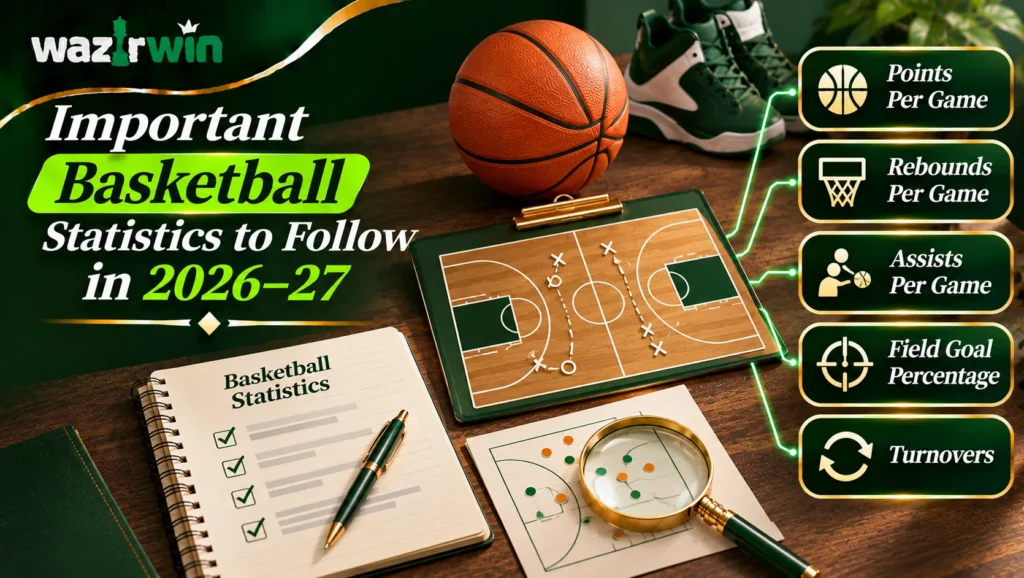
| Statistic | What it measures |
| Points per game | Average scoring output |
| Rebounds per game | Average rebounds collected |
| Assists per game | Average assists recorded |
| Field-goal percentage | Overall shooting accuracy |
| Three-point percentage | Perimeter shooting accuracy |
| Free-throw percentage | Free-throw accuracy |
| Turnovers | Lost possessions |
| Offensive rating | Points scored per 100 possessions |
| Defensive rating | Points allowed per 100 possessions |
| Pace | Estimated possessions per 48 minutes |
This provides a greater understanding to users of Basketball Betting Trends of both individual players and their respective teams’.
Final Thoughts
The upcoming 2026-27 NBA season will include many story lines related to basketball statistics including efficient players and teams, the ever increasing three point shot attempts and related shooting percentages. Also of importance are issues surrounding defense including rebounding, and a variety of scheduling conflicts. When studying Basketball Betting Trends it is wise to look at many statistics and take into account many circumstances of a team including current injuries, recent statistics, player style, and other external factors.
While no model is 100% perfect, by incorporating many different statistics, WazirWin will be able to give NBA fans great sports information as well as ways to utilize online sports features responsibly while minimizing risk of financial loss during the upcoming NBA season.
Frequently Asked Questions (FAQs)
1. What are the major Basketball Betting Trends to watch in the 2026–27 NBA season?
Key trends to monitor in Basketball Betting Trends for the 2026–27 NBA season, in detail, include: advanced player statistics, trends in three-point shooting metrics, player injuries and their pending return to basketball action, home and away performance of basketball teams, defensive efficiency statistics, and a comprehensive look at the NBA schedule for said season.
2. Why are advanced player statistics important in Basketball Betting Trends?
Here we refer to some of the key statistics to measure individual players, such as the Player Efficiency Rating (PER), the True Shooting Percentage (TS%) and the players’ Usage Rate.
3. How does three-point shooting influence basketball match analysis?
To evaluate a team’s scoring efficiency in the NBA and therefore their overall offensive strategy, we need to look at the volume of three-point attempts a team takes, their three-point shooting percentage, and the three-point defense of the opponent.
4. Why should NBA injury reports be checked before analysing a match?
These provide details of any players currently on the team’s injury list. How long they will be out for and how the team will adjust their line-up as a result.
5. How do home and away records affect Basketball Betting Trends?
Home and away performance statistics show the degree to which a team plays consistently. Scoring, defense and overall performance can vary greatly from home to away games.
6. Why are back-to-back games important in NBA analysis?
As far as challenges posed by back-to-back games in NBA games are concerned, we refer to the time that a player needs to recover from the exertion of a game, to the changes in a team’s line-up and to the affected team performance caused by the short rest of time between games.
7. How do rebounding and defensive statistics help evaluate NBA teams?
Examples of these types of Basketball statistics are the amount of offensive and defensive rebounds per game, the amount of steals and blocks per game and the opposition’s defensive rating.
8. What role does live match data play in Basketball Betting Trends?
The real-time data provided for live matches such as scores, player statistics (points, assists, rebounds, etc.) plus fouls committed, enables you to gain up-to-the-minute insight of the game currently being played.
9. How does the Emirates NBA Cup influence the NBA season?
The Emirates NBA Cup incorporates a group stage followed by a knock-out phase to be included in the regular season ranking of the participating teams.
10. Why should multiple statistics be considered before analysing an NBA matchup?
Consider many statistics such as a team’s recent player form, key player injuries, shooting stats, and the team’s past rebounding and turnover numbers as well as their current schedule.